


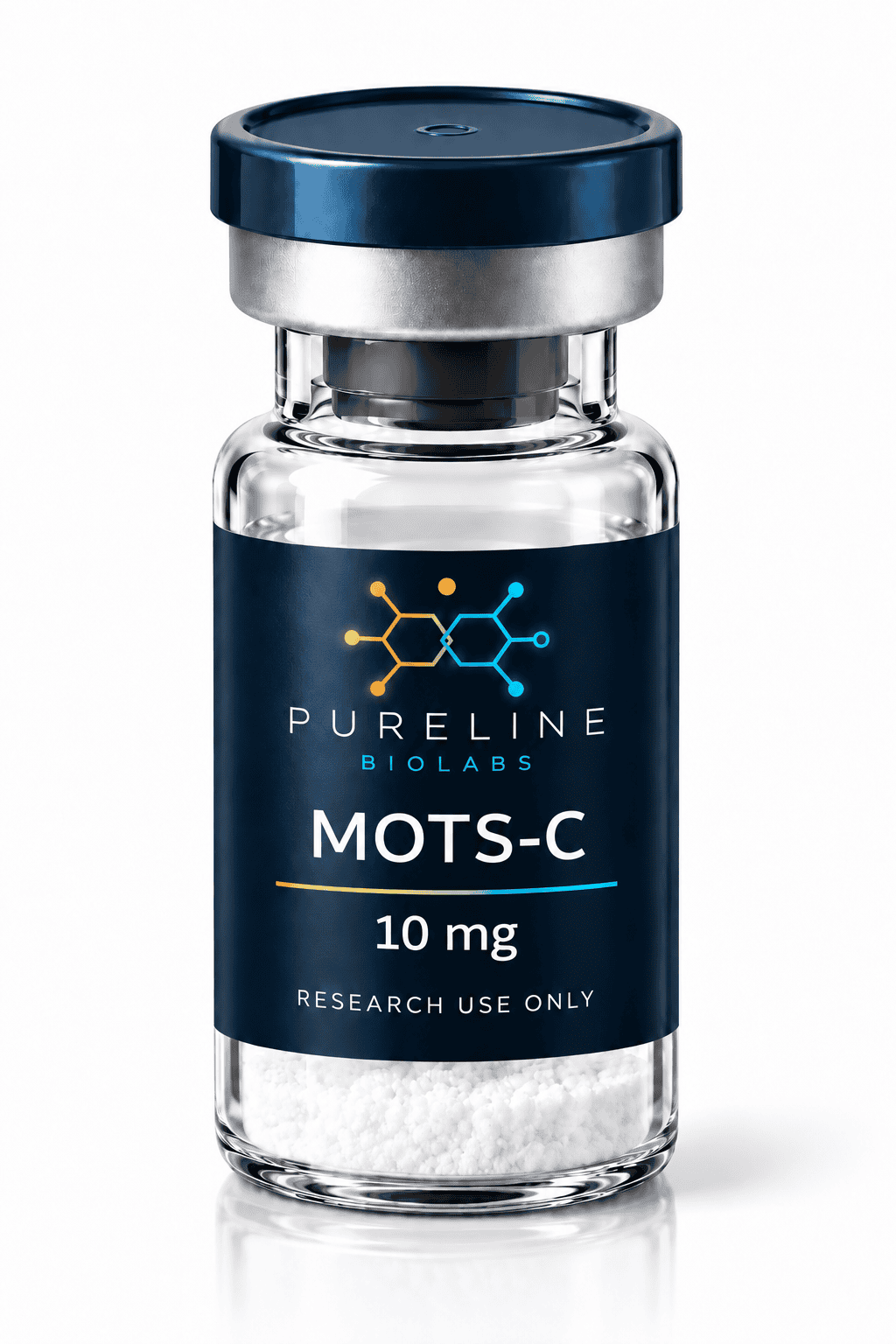
Mitochondrial Open Reading Frame of the 12S rRNA-c — 10mg
Buy MOTS-c UK from Pureline Biolabs. MOTS-c is a 16-amino-acid peptide encoded within the 12S rRNA gene of the mitochondrial genome. Supplied as lyophilised powder for laboratory research and studied in metabolic and mitochondrial-biology research models. Independently verified at 98.123% purity by Janoshik Analytical.
39.99
Inc. VAT · Free UK delivery over £75
Batch PLB-008 · Janoshik Analytical · 98.123% purity confirmed
About MOTS-c
MOTS-c (Mitochondrial Open Reading Frame of the 12S rRNA-c) is a 16-amino acid peptide encoded within the mitochondrial genome — specifically within the 12S rRNA gene. It belongs to the mitochondrial-derived peptides (MDPs), a group of peptides encoded in mitochondrial DNA that researchers study as possible signals between mitochondria, the cell nucleus and other tissues.
The published research on MOTS-c, including the limits of what it shows, is reviewed on our MOTS-c compound profile. Most of that literature comes from cell and animal models, and it does not describe the effects of research-grade material.
All Pureline Biolabs MOTS-c is supplied as a lyophilised powder in sealed vials, independently tested by Janoshik Analytical at 98.123% purity.
Product Specifications
| Compound | MOTS-c |
| Full name | Mitochondrial ORF of 12S rRNA-c |
| Origin | Mitochondrial genome encoded |
| Amino acids | 16 |
| Molecular formula | C101H152N28O22S2 |
| Molecular weight | 2174.62 g/mol |
| CAS number | 1627580-64-6 (free peptide) |
| PubChem CID | 146675088 |
| Vial size | 10mg lyophilised powder |
| Purity | 98.123% — Janoshik verified |
| Form | Lyophilised powder, sealed vial |
| Manufacturing | Batch-Tested on Receipt |
| Batch | PLB-008 |
| Research use only | Not for human consumption |
Research Background
MOTS-c has been studied in metabolic, mitochondrial and ageing-biology research. The areas below describe what studies measured, not established effects. For the full evidence review, see the MOTS-c compound profile. This product is supplied for laboratory research purposes only.
Rodent studies have measured glucose tolerance, insulin signalling and glucose-transporter expression in skeletal muscle.
Cell and animal studies have measured AMPK pathway activation in muscle and liver tissue.
Studies have measured fatty acid oxidation and mitochondrial biogenesis markers.
Studies have compared circulating MOTS-c levels between younger and older subjects and animals.
Rodent diet-induced obesity models have used adipose tissue and metabolic-rate measurements as endpoints.
Cell studies have tracked MOTS-c movement to the nucleus under stress and measured stress-response gene expression.
Store in refrigerator. Keep away from direct light and heat sources.
Use within 28 days. Do not refreeze once reconstituted.
Stable for up to 24 months when frozen as lyophilised powder.
Standard refrigerator storage conditions are sufficient. Protect from prolonged direct light.
Reconstitution Guide
MOTS-c is supplied as a lyophilised powder and must be reconstituted with bacteriostatic water before use in research applications.
Allow vial to reach room temperature. Clean the rubber stopper with an alcohol swab and allow to dry completely.
Draw required volume of BAC water into a sterile syringe. Inject slowly down the inside of the vial wall — not directly onto the powder.
Gently swirl until powder fully dissolves. Do not shake. Solution should be clear and colourless. MOTS-c dissolves readily in BAC water.
Use our Reconstitution Calculator → for exact volumes.
Customer Reviews
Buying MOTS-c in the UK — common questions
What purity is Pureline’s MOTS-c, and who tested it?
Batch PLB-008 was reported at 98.123% by HPLC at Janoshik Analytical, with LC-MS supporting the assigned molecular identity. That is an area-percent figure under the laboratory’s stated method — the chromatographic purity of the tested sample, not a claim about biological activity. The purity figures guide explains why a 98% and a 99% figure are closer than they look.
How much bacteriostatic water does a 10mg MOTS-c vial need?
2ml gives 5 mg/ml and 3ml gives roughly 3.33 mg/ml — mass divided by volume. The reconstitution calculator has the 10mg vial loaded, and the reconstitution guide covers the adsorption losses that matter most at low working concentrations.
What makes MOTS-c different from the other metabolic research peptides?
Its origin. MOTS-c is a short peptide encoded in mitochondrial DNA rather than in the nuclear genome, which is why it is discussed as a mitochondrial-derived peptide and studied in mitochondrial and metabolic biology rather than in receptor-agonist pharmacology. A triple agonist such as retatrutide addresses an entirely different set of research questions.
Does the sequence affect how it should be handled?
Yes. MOTS-c carries methionine and tryptophan residues, both of which are prone to oxidation, so DMSO is best avoided as a solvent where an alternative exists and solutions should be kept cold and out of the light. Bacteriostatic water is the standard diluent for routine work.
How should MOTS-c be stored?
Sealed and lyophilised at 2–8°C away from light; it ships cold chain from the UK. Once in solution, refrigerate at 2–8°C and aliquot into single-use portions before freezing so the stock takes one freeze-thaw cycle rather than one per use. Let a closed vial reach room temperature before opening — lyophilised powder is hygroscopic.
Can I see the Certificate of Analysis before I order?
Yes. Every batch report is published on our independent lab reports page before the stock is listed, and the batch number on the report matches the number printed on your vial. The label carries a QR code that opens the report on Janoshik’s own verification server.
Is MOTS-c legal to buy in the UK?
It is supplied strictly as a research chemical for in vitro laboratory use. MOTS-c holds no UK marketing authorisation and is not a licensed medicine here, so it is not sold for human or veterinary use. The UK peptide law guide sets out how research-use materials sit within the regulations.
All products sold by Pureline Biolabs Ltd are intended strictly for laboratory research purposes only. Not approved for human consumption, veterinary use, or any other application. Not evaluated by the MHRA or any other regulatory authority. Pureline Biolabs Ltd · Company No. 17236739 · purelinebiolabs.com
Reviews
There are no reviews yet