Ipamorelin: Structure, Research Evidence and Batch Testing
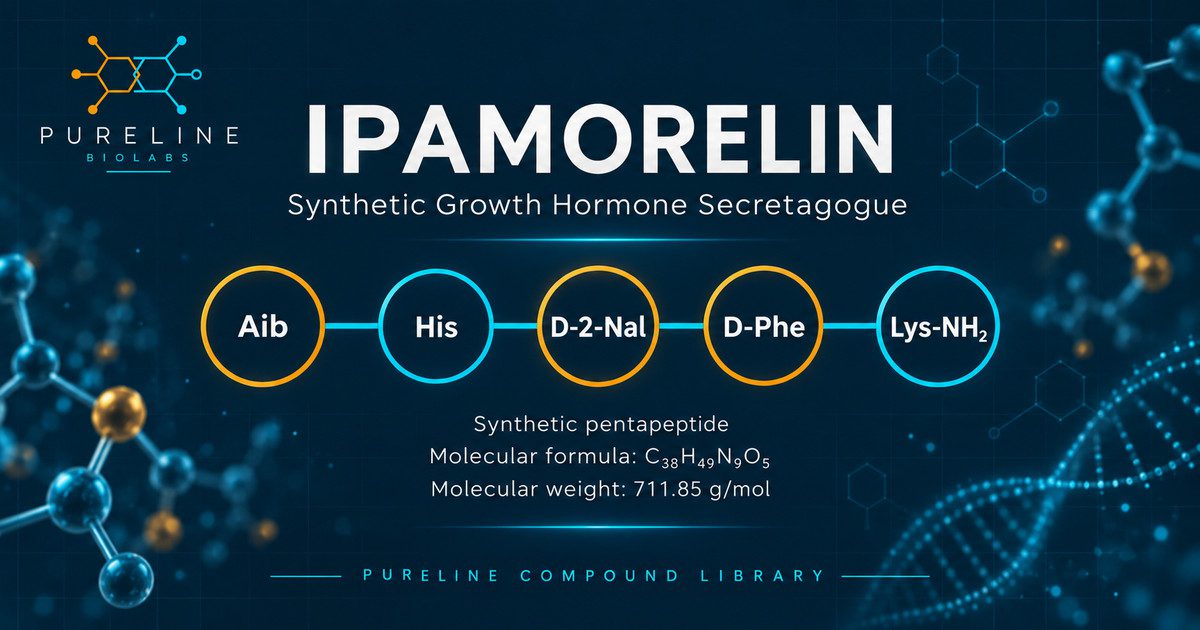
Ipamorelin is a synthetic pentapeptide growth hormone secretagogue with the sequence Aib-His-D-2-Nal-D-Phe-Lys-NH2. It was designed within the growth hormone-releasing peptide family and has been investigated for its interaction with the growth hormone secretagogue receptor system and its effect on growth hormone release. The evidence includes pituitary-cell experiments, animal studies, a small human pharmacokinetic study and a Phase 2 clinical trial. Results from one research level should not be assumed to establish an outcome at another.
Pureline Biolabs publishes independent, batch-specific analytical results for the Ipamorelin stock it supplies. These reports describe the sample tested from that batch. They do not demonstrate biological activity, clinical efficacy, safety, sterility or suitability for any particular application.
Chemical Identity
| Field | Information |
|---|---|
| Standard name | Ipamorelin |
| Development code | NNC 26-0161 |
| Classification | Synthetic pentapeptide growth hormone secretagogue |
| Sequence | Aib-His-D-2-Nal-D-Phe-Lys-NH2 |
| Residue count | Five |
| Molecular formula | C38H49N9O5 |
| Molecular weight | 711.85 g/mol |
| CAS number | 170851-70-4 |
| PubChem CID | 9831659 |
| FDA UNII | Y9M3S784Z6 |
| First reported | 1998 |
| Original developer | Novo Nordisk A/S |
| Form supplied | Lyophilised powder in a sealed vial |
| Pureline storage | 2-8°C, dark and dry |
| Pureline classification | Laboratory research material only. Not intended for human, veterinary, cosmetic or dietary use. |
For general laboratory handling principles, see the Pureline Biolabs peptide reconstitution guide and reconstitution calculator.
Ipamorelin is not composed solely of the standard amino acids found in ordinary proteins. Aib is alpha-aminoisobutyric acid, while D-2-Nal is D-2-naphthylalanine. The sequence also contains D-phenylalanine and ends in an amidated lysine residue. This means that residue identity, stereochemistry and terminal modification all form part of the compound's analytical identity. A list of five abbreviated residues without these details does not describe Ipamorelin fully.[1,2]
The molecular formula above describes the parent structure represented in the cited chemical records. A salt or counterion can change the reported composition and mass, so the form stated on a supplier specification should be checked separately.
Evidence by Research Level
Cell-Based Research
The original 1998 study tested Ipamorelin in primary rat pituitary cells. It reported growth hormone release with a potency and efficacy similar to GHRP-6. The investigators concluded that Ipamorelin is a growth hormone-releasing peptide receptor agonist rather than acting through the growth hormone-releasing hormone receptor. This experiment measured hormone release from isolated rat pituitary cells. It did not investigate body composition, recovery, sleep, ageing or clinical outcomes.[3]
Animal Research
The same foundational study examined anaesthetised rats and conscious swine. Ipamorelin produced measurable growth hormone release in both models with a potency comparable to GHRP-6. In swine, the investigators reported that Ipamorelin did not release ACTH or cortisol at levels significantly different from those observed following growth hormone-releasing hormone stimulation. They also reported no effect on FSH, LH, prolactin or TSH. That combination is the basis for describing Ipamorelin as selective, but it came from a defined animal experiment and should not be treated as proof that no other hormonal or biological effects can occur.[3]
A separate study administered Ipamorelin to young adult female rats by continuous subcutaneous infusion for twelve weeks. It reported increases in total bone mineral content and in bone dimensions. The investigators attributed those increases to increased growth of the bones rather than to denser bone tissue: volumetric bone mineral density was unchanged. This distinction matters because a larger measured bone is not the same finding as denser bone tissue.[4]
A rodent postoperative-ileus model has also examined Ipamorelin as a ghrelin mimetic. Male Sprague-Dawley rats underwent laparotomy with intestinal manipulation, and the study reported effects on postsurgical colonic transit time, faecal pellet output, food intake and body weight. Those findings led to clinical investigation, but the animal gastrointestinal results did not predict a successful clinical efficacy outcome.[5]
Human Pharmacokinetic Research
A 1999 study examined intravenous Ipamorelin in healthy male volunteers. Eight participants were studied at each of five infusion rates. The researchers reported dose-proportional pharmacokinetics, a short terminal half-life of approximately two hours under those study conditions, and a growth hormone response following infusion. This study characterised concentration and hormone-response relationships. It did not test muscle gain, fat loss, exercise recovery, sleep quality or anti-ageing outcomes.[6]
Phase 2 Human Research
A multicentre, double-blind, placebo-controlled Phase 2 trial enrolled 114 adults undergoing small and large bowel resection. Participants received intravenous Ipamorelin at 0.03 mg/kg or matching placebo twice daily, from postoperative day 1 through day 7 or discharge. The principal efficacy endpoint was the time from the first dose of study drug to tolerance of a standardised solid meal.[7,8]
Median time to meal tolerance was 25.3 hours with Ipamorelin and 32.6 hours with placebo, a difference that was not statistically significant at p=0.15. The investigators reported no significant differences in the efficacy analyses. Adverse events occurred in 87.5 per cent of the Ipamorelin group and 94.8 per cent of the placebo group, and the investigators described the treatment as well tolerated within this short, controlled trial. That tolerability finding should not be generalised to different formulations, populations, durations or uses.[7]
The trial therefore confirms that Ipamorelin reached Phase 2 human investigation. It does not establish efficacy for postoperative ileus, and it provides no clinical evidence for the fitness, body-composition, recovery or anti-ageing claims frequently associated with the compound online.
Not Established
What the evidence does not show
- No published study has evaluated Pureline's specific Ipamorelin batch for biological activity or clinical outcomes.
- No reliable human trial has established that Ipamorelin increases muscle mass, reduces body fat, improves sleep, speeds exercise recovery or slows ageing.
- The Phase 2 postoperative-ileus trial did not meet its principal efficacy endpoint.
- Selectivity reported in pituitary-cell and animal studies does not mean that the compound has no other biological effects.
- A short human pharmacokinetic study does not establish safety during repeated or long-term exposure.
- Evidence for Ipamorelin alone cannot be used to establish the effect of mixtures containing CJC-1295 or another research compound.
- No UK marketing authorisation has been identified for Ipamorelin.
- Analytical purity does not establish sterility, endotoxin level, biological activity or suitability for use in humans or animals.
Limitations worth knowing
- The foundational selectivity evidence came largely from rat pituitary cells, rats and swine.
- Study routes and formulations differ, so results are not directly transferable between experiments.
- The healthy-volunteer study measured pharmacokinetics and growth hormone response rather than patient benefit.
- The published Phase 2 trial concerned postoperative gastrointestinal recovery, not body composition or physical performance.
- Several structural forms and salt descriptions appear in commercial catalogues, so formula and mass should be matched to the stated material.
- D-amino acids, the non-standard Aib and D-2-Nal residues, and C-terminal amidation make stereochemical identity especially relevant.
- A result from one tested batch cannot certify a different batch or every vial without a defined sampling plan.
The Pureline Testing Standard
How this batch was verified
Pureline sends a sealed sample from each Ipamorelin batch to Janoshik Analytical before releasing that batch for sale. The laboratory report is linked to the same batch code used on the vial and in Pureline's batch records. This allows researchers to inspect the external report rather than relying on a supplier-created certificate alone.
Current Pureline Batch
The values above come from the laboratory report for the sample tested from batch PLB-004. This panel is updated when Pureline changes to a new batch.
Testing Methods Explained
| Method | What it actually shows |
|---|---|
| HPLC | Reports chromatographic purity from relative peak area under the stated test conditions. It does not determine absolute vial quantity by itself. |
| LC-MS | Supports the assigned molecular identity through the detected mass information. It does not establish biological activity or clinical effect. |
| Quantity analysis | Estimates how much target material the tested sample contains under the laboratory's stated method and calibration. |
| Endotoxin testing | Measures bacterial endotoxin separately from chemical identity and chromatographic purity. |
| Sterility testing | Assesses microbial growth using a specified test procedure. HPLC and LC-MS do not establish sterility. |
A high HPLC percentage answers a narrow analytical question. It should not be presented as proof of exact quantity, sterility, endotoxin status, safety or performance unless those matters were examined separately.
Common Questions
What is Ipamorelin?
Ipamorelin is a synthetic pentapeptide growth hormone secretagogue. Its full abbreviated sequence is Aib-His-D-2-Nal-D-Phe-Lys-NH2. Research has examined its activity within the growth hormone secretagogue receptor system and its ability to trigger growth hormone release in experimental models.
Why is the Ipamorelin sequence different from an ordinary peptide sequence?
The sequence includes non-standard residues and defined stereochemistry. Aib and D-2-Nal are not among the ordinary protein-forming amino acids, D-Phe has the opposite stereochemical configuration from L-phenylalanine, and the C-terminus is amidated. Identity therefore depends on more than the five residue names alone.
What does it mean when Ipamorelin is called selective?
In the foundational study, Ipamorelin produced growth hormone release while ACTH and cortisol responses in swine were not significantly different from those seen with growth hormone-releasing hormone, and no effect was reported on FSH, LH, prolactin or TSH. This was selectivity within a defined experimental comparison. It does not mean Ipamorelin acts only in one place, has no other effects or has proven long-term safety in humans.
Does the human Phase 2 trial prove that Ipamorelin works?
No. The postoperative-ileus trial found no statistically significant difference between Ipamorelin and placebo in its principal efficacy endpoint. It shows that the compound underwent controlled human investigation, not that the proposed treatment succeeded.
Is Ipamorelin the same as CJC-1295?
No. Ipamorelin is a growth hormone secretagogue receptor agonist. CJC-1295 is a growth hormone-releasing hormone analogue that acts through a different receptor system. Evidence concerning one compound does not prove the performance or safety of the other, and studies of Ipamorelin alone do not establish the effects of a mixture.
What does the Pureline Certificate of Analysis verify?
The Janoshik report provides analytical findings for the sample submitted from the stated batch. LC-MS supports the assigned molecular identity, HPLC reports chromatographic purity under the stated conditions, and the report lists the measured amount. These results do not establish sterility, endotoxin level, biological activity, safety or a clinical outcome unless the report includes separate tests for those questions.
References
- National Center for Biotechnology Information. Ipamorelin. PubChem CID 9831659. PubChem
- US Food and Drug Administration. Ipamorelin, UNII Y9M3S784Z6. FDA Substance Registration System
- Raun K, Hansen BS, Johansen NL, et al. Ipamorelin, the first selective growth hormone secretagogue. Eur J Endocrinol. 1998;139(5):552-561. PubMed 9849822
- Svensson J, Lall S, Dickson SL, et al. The GH secretagogues ipamorelin and GH-releasing peptide-6 increase bone mineral content in adult female rats. J Endocrinol. 2000;165(3):569-577. PubMed 10828840
- Venkova K, Mann W, Nelson R, Greenwood-Van Meerveld B. Efficacy of ipamorelin, a novel ghrelin mimetic, in a rodent model of postoperative ileus. J Pharmacol Exp Ther. 2009;329(3):1110-1116. PubMed 19289567
- Gobburu JVS, Agersø H, Jusko WJ, Ynddal L. Pharmacokinetic-pharmacodynamic modeling of ipamorelin, a growth hormone releasing peptide, in human volunteers. Pharm Res. 1999;16(9):1412-1416. PubMed 10496658
- Beck DE, Sweeney WB, McCarter MD, Ipamorelin 201 Study Group. Prospective, randomized, controlled, proof-of-concept study of the ghrelin mimetic ipamorelin for the management of postoperative ileus in bowel resection patients. Int J Colorectal Dis. 2014;29(12):1527-1534. PubMed 25331030
- ClinicalTrials.gov. Study of Ipamorelin for the Management of Postoperative Ileus in Patients Undergoing Bowel Resection. NCT00672074. ClinicalTrials.gov
All products sold by Pureline Biolabs Ltd are intended strictly for laboratory research purposes only. Not approved for human consumption, veterinary use, or any other application. Not evaluated by the MHRA or any other regulatory authority. Pureline Biolabs Ltd · Company No. 17236739 · purelinebiolabs.com