Kisspeptin-10 Peptide: Sequence, Research Evidence and Batch Testing
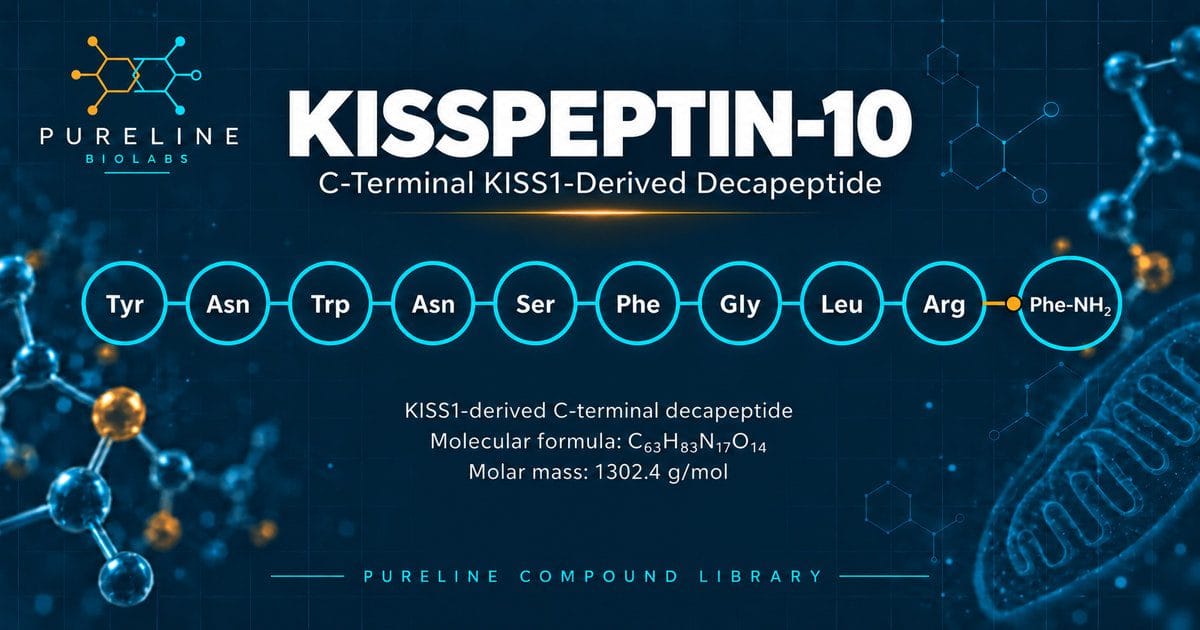
Kisspeptin-10 is a C-terminally amidated decapeptide with the sequence Tyr-Asn-Trp-Asn-Ser-Phe-Gly-Leu-Arg-Phe-NH2, abbreviated YNWNSFGLRF-NH2. It is the final ten residues shared by the active human kisspeptin peptides produced from the KISS1 precursor. Researchers also refer to it as KP-10, Metastin (45-54) amide and KISS1 (112-121) amide.
Cell and animal studies have examined Kisspeptin-10 as a ligand for the KISS1 receptor, also called KISS1R or GPR54. Human experimental studies have measured reproductive-hormone responses following controlled intravenous administration under supervised protocols, in small groups. Those studies answer narrow research questions. They do not establish that a separately manufactured research vial is approved, safe or suitable for administration.
Pureline Biolabs supplies Kisspeptin-10 10mg as a laboratory research material only. Published papers describe the compound under the exact conditions used by their authors. Pureline's independent batch report concerns the submitted sample from the stock Pureline holds. General literature cannot certify a Pureline batch, and a batch report cannot prove a biological outcome.
Chemical Identity
| Field | Information |
|---|---|
| Standard name | Kisspeptin-10 |
| Common abbreviations | KP-10, Kp-10 |
| Sequence | Tyr-Asn-Trp-Asn-Ser-Phe-Gly-Leu-Arg-Phe-NH2 |
| One-letter sequence | YNWNSFGLRF-NH2 |
| Peptide length | Ten amino-acid residues |
| C-terminal form | Amidated, Phe-NH2 |
| Peptide class | KISS1-derived RFamide decapeptide |
| Human precursor position | KISS1 residues 112-121 |
| Metastin position | Metastin residues 45-54 |
| Molecular formula | C63H83N17O14 |
| Molar mass | 1302.4 g/mol |
| CAS number | 374675-21-5 |
| PubChem CID | 25240297 |
| Primary receptor studied | KISS1R, formerly GPR54 |
| Research categories | Receptor signalling, neuroendocrine biology and reproductive-axis research |
| Form supplied by Pureline | Kisspeptin-10 10mg, lyophilised laboratory research material |
| Pureline classification | For laboratory research use only. Not for human consumption or veterinary use. |
For general laboratory handling principles, see the Pureline Biolabs peptide reconstitution guide and reconstitution calculator.
PubChem records amidated human Kisspeptin-10 as C63H83N17O14 with a molecular weight of 1302.4 g/mol.[1] Acetate, trifluoroacetate, water or other associated components can change the total composition of supplied material. The batch report should state which form and mass basis it addresses.
How Kisspeptin-10 Relates to KISS1 and Metastin
The human KISS1 gene encodes a larger precursor protein.[8] Processing produces several kisspeptin forms that share the same amidated C-terminal sequence. Kisspeptin-54, historically called metastin, contains 54 residues. Kisspeptin-10 contains its final ten residues and retains receptor activity.[2,3]
| Name | What it describes |
|---|---|
| Kisspeptin-10 or KP-10 | The ten-residue active C-terminal peptide |
| KISS1 (112-121) amide | Its position within the human KISS1 precursor |
| Metastin (45-54) amide | Its position within 54-residue metastin |
| YNWNSFGLRF-NH2 | Its one-letter sequence and C-terminal amidation |
The terminal RF-NH2 motif places Kisspeptin-10 within the RFamide peptide group. The NH2 is part of its chemical identity and should remain visible in sequence tables, image labels and analytical records. Writing only YNWNSFGLRF leaves out that modification.
Evidence by Research Level
Kisspeptin-10 research includes receptor assays, cultured-cell experiments, animal models and controlled human physiology studies. These levels should not be merged into one broad claim.
Chemical and Receptor Characterisation
Kisspeptin-10 has a defined ten-residue sequence, C-terminal amide and calculated molecular mass. Studies published in 2001 identified KISS1-derived peptides as ligands for the receptor then known as GPR54.[2,3] The receptor is now generally called KISS1R.
Receptor activation has been studied through intracellular calcium and signalling assays. These tests can show activity in a specified receptor system. They do not establish clinical effectiveness, product purity, exact vial quantity or safety.
In-Vitro Research
Cell studies have examined binding and signalling at human and animal KISS1R. The C-terminal decapeptide contains the shared receptor-active region found across the longer kisspeptin forms.[2,3]
Other laboratory work has examined downstream phospholipase C, intracellular calcium and related signalling pathways. The measured response depends on receptor expression, cell type, concentration and assay design. A cell response cannot define an outcome in a person.
Animal Research
Animal studies have investigated how Kisspeptin-10 relates to gonadotropin-releasing hormone signalling and downstream hormone release. A 2004 study reported responses following central and peripheral administration in rodent models and included in-vitro hypothalamic work.[4]
Animal experiments have also examined reproductive timing, feedback systems and KISS1R signalling in different physiological states. Species, sex, reproductive stage, route and sampling schedule can materially change the result. These findings cannot set a human-use claim.
Human Research
Kisspeptin-10 is unusual among the compounds in this library in that synthetic peptide has been administered to people under controlled research conditions. A 2011 study gave intravenous Kisspeptin-10 to healthy adult men as bolus doses and as continuous infusion. It reported a rapid, dose-dependent rise in serum luteinising hormone and an increase in LH pulse frequency from 0.7 to 1.0 pulses per hour during infusion. Each dosing group contained between four and six men.[5]
A second 2011 study reported that responses differed between men and women and across phases of the menstrual cycle.[6] A 2015 study directly compared Kisspeptin-10, Kisspeptin-54 and gonadotropin-releasing hormone in healthy men.[7]
These studies show that the molecule has been investigated in people, in supervised settings, at defined intravenous doses, in groups small enough to count on two hands. They do not turn retail research material into an authorised medicine, and results from one population or protocol do not transfer automatically to another.
Human studies of Kisspeptin-54 should not be described as Kisspeptin-10 trials. The two peptides share a C-terminal sequence but differ in length, molecular mass, pharmacokinetic behaviour and research protocol.
Evidence Summary
| Research level | What has been studied | Main limit |
|---|---|---|
| Chemical identity | Sequence, amidation, formula and molar mass | Does not establish biological activity or batch quality |
| Receptor and cell work | KISS1R binding and intracellular signalling | Assay findings do not establish a human outcome |
| Animal work | GnRH-linked signalling, gonadotropin release and reproductive models | Animal results cannot define human safety or effectiveness |
| Human experimental work | Short controlled intravenous studies of hormone responses | Groups of four to six; narrow protocols do not establish an approved treatment |
| Pureline batch analysis | Reported purity and quantity of the submitted stock sample | Does not establish safety, effectiveness, sterility or uniformity across every vial |
What Is Not Established
No cited study has tested Pureline Biolabs' current Kisspeptin-10 batch for a biological or clinical outcome. Literature about Kisspeptin-10 cannot certify a retail vial.
The evidence does not establish
- That Kisspeptin-10 is an approved medicine in the United Kingdom
- That Pureline's research material is suitable for human or animal administration
- That short human physiology studies provide a general treatment claim
- That Kisspeptin-54 trial findings apply directly to Kisspeptin-10
- That findings from receptor assays or animals will occur in people
- That Pureline's material matches every preparation used in published work
- That HPLC purity proves identity, exact vial amount, sterility or endotoxin status
- That one submitted sample certifies every vial or any later batch
Limitations worth knowing
- Kisspeptin-10 and Kisspeptin-54 are related but chemically different peptides
- Human findings depend on sex, reproductive stage, protocol and sampling period
- The human studies cited here used groups of four to six participants per dose and short observation periods
- Published human administration was intravenous under supervision, which is not comparable to any other route or setting
- Hormone changes are laboratory endpoints, not proof of a clinical benefit
- KISS1R signalling outside the core reproductive-axis literature remains under study
- The C-terminal amide must be included when describing chemical identity
- Counterions and residual water can alter the total composition of a supplied sample
- HPLC peak-area purity does not measure exact vial quantity
- Intact-mass analysis supports identity but does not prove every bond or sequence position
- A submitted sample does not prove uniformity across an entire batch
- Storage stability depends on material form, residual moisture, container closure, temperature, light and time
What Pureline Biolabs Independently Adds
First-party evidence
Many Kisspeptin-10 pages mix receptor biology, human research and sales claims. Pureline keeps those categories separate and adds records tied to its own stock: the batch code printed on the vial, the independent analytical laboratory, the laboratory task number and direct verification key, the reported results, links connecting the product, the report and the current batch record, and a cold-chain record covering storage and handling while the stock remained under Pureline's control.
This helps a reader distinguish the known chemistry and published research from the measured features of Pureline's submitted sample.
Current Pureline Batch
The values above are taken from the Janoshik report for the sample submitted from batch PLB-010. The reported amount of 10.60mg is above the 10mg labelled vial size; Pureline publishes the measured figure rather than the label figure, in either direction. The certificate names the submitted sample as Kisspeptin; Pureline is standardising its submission labelling to Kisspeptin-10 so that future reports state the decapeptide explicitly rather than the compound family. This certificate reports quantity and chromatographic purity, and does not report a separate sterility, endotoxin or sequence-confirmation result. The panel is updated when Pureline changes to a new batch, and earlier reports are kept under their original batch codes rather than replaced.
The Pureline Testing Standard
What a Kisspeptin-10 batch record should contain
- HPLC to report relative chromatographic peak-area purity
- Mass spectrometry to test consistency with the expected molecular mass
- Clear identification of the amidated form used as the analytical reference
- Quantity analysis when the vial amount is described as independently measured
- A visible Pureline batch code connecting the vial and the report
- Separate sterility, endotoxin or heavy-metal results only when commissioned for that batch
Testing Methods Explained
| Method | What it shows | What it does not show by itself |
|---|---|---|
| HPLC | Relative chromatographic peak-area purity under the stated method | Full identity, exact vial amount, sterility or endotoxin level |
| LC-MS | Whether detected mass data are consistent with expected Kisspeptin-10 | Complete sequence proof, exact quantity, sterility or biological activity |
| Quantity analysis | Amount of target material measured in the submitted sample | Purity, sterility, safety or clinical effect |
| Peptide mapping or fragmentation | Extra sequence information, depending on method and coverage | Automatic proof of every structural or stereochemical feature |
| Endotoxin test | Bacterial endotoxin level under the named method | Chemical identity or general sterility |
| Sterility test | Microbial growth under defined test conditions | Chemical purity, identity or suitability for administration |
A 99 per cent HPLC result refers to the proportion of detected chromatographic peak area assigned to the target peak under that method. It does not mean that the vial is 99 per cent correctly filled, 99 per cent sterile or 99 per cent safe.
Storage and Traceability
Pureline stores Kisspeptin-10 according to the conditions printed on its label and batch documentation. The cold-chain log records storage and handling while the material remains under Pureline's control. It does not replace analytical testing or prove that no degradation occurred.
Stability depends on peptide form, counterion, residual moisture, container closure, temperature, light and time. A general storage statement cannot provide a validated shelf life for every preparation.
Common Questions
What is Kisspeptin-10 peptide?
Kisspeptin-10 is an amidated ten-residue peptide derived from the C-terminal region of human KISS1. Its sequence is YNWNSFGLRF-NH2, and researchers commonly abbreviate it as KP-10.
What is the Kisspeptin-10 sequence?
The sequence is Tyr-Asn-Trp-Asn-Ser-Phe-Gly-Leu-Arg-Phe-NH2. The NH2 identifies its C-terminal amide and forms part of the molecule's chemical identity.
What are the Kisspeptin-10 molecular formula and molecular weight?
PubChem records C63H83N17O14 and a molecular weight of 1302.4 g/mol for human Kisspeptin-10. A supplied salt or hydrate can have a different total composition.
Is Kisspeptin-10 naturally occurring or synthetic?
The sequence represents the active C-terminal decapeptide shared by naturally produced human kisspeptins. Pureline supplies a synthetically manufactured laboratory research material. A shared sequence does not make a manufactured vial biologically identical to peptide released within a living system.
Is Kisspeptin-10 the same as Kisspeptin-54?
No. Kisspeptin-10 contains the final ten residues of Kisspeptin-54, but the molecules differ in length, formula, mass and research behaviour. Evidence from a Kisspeptin-54 study should be labelled as Kisspeptin-54 evidence.
Are metastin and Kisspeptin-10 the same?
Metastin usually refers to Kisspeptin-54. The name Metastin (45-54) amide refers specifically to its final ten residues, which are Kisspeptin-10.
What receptor does Kisspeptin-10 target in research?
Researchers study Kisspeptin-10 as a ligand for KISS1R, the receptor formerly called GPR54. Receptor activity in an assay does not prove a clinical effect.
Has Kisspeptin-10 been studied in humans?
Yes, and more directly than most research peptides. Controlled studies have administered intravenous Kisspeptin-10 to healthy volunteers under supervision and measured hormone responses in men and women. Those studies used small groups, typically four to six participants per dose, over short observation periods. They do not authorise general human use of laboratory research material.
Is Kisspeptin-10 approved as a medicine in the UK?
No. The research cited on this page does not establish UK marketing authorisation for Kisspeptin-10. Pureline supplies it only as a laboratory research material.
How is Pureline Biolabs Kisspeptin-10 tested?
Pureline submits a sealed sample from each batch to Janoshik Analytical before release. For batch PLB-010 the laboratory reported 99.890 per cent purity and a measured amount of 10.60mg under task number 209944, and the report can be checked directly through the verification link in the batch record above.
What does a Kisspeptin-10 Certificate of Analysis prove?
It supports only what the listed methods measured in the submitted sample. Purity and quantity results do not establish clinical safety, effectiveness, sterility, endotoxin level or suitability for administration.
Where can I verify Pureline's Kisspeptin-10 batch?
Match the batch code on the vial with the live page record, then use the direct laboratory-verification link. Check Pureline's cold-chain log separately for the storage record linked to that stock.
References
- National Center for Biotechnology Information. Kisspeptin-10. PubChem CID 25240297. PubChem
- Ohtaki T, Shintani Y, Honda S, et al. Metastasis suppressor gene KiSS-1 encodes peptide ligand of a G-protein-coupled receptor. Nature. 2001;411:613-617. PubMed 11385580
- Kotani M, Detheux M, Vandenbogaerde A, et al. The metastasis suppressor gene KiSS-1 encodes kisspeptins, the natural ligands of the orphan G protein-coupled receptor GPR54. J Biol Chem. 2001;276:34631-34636. PubMed 11457843
- Thompson EL, Patterson M, Murphy KG, et al. Central and peripheral administration of kisspeptin-10 stimulates the hypothalamic-pituitary-gonadal axis. J Neuroendocrinol. 2004;16:850-858. PubMed 15500545
- George JT, Veldhuis JD, Roseweir AK, et al. Kisspeptin-10 is a potent stimulator of LH and increases pulse frequency in men. J Clin Endocrinol Metab. 2011;96:E1228-E1236. PubMed 21632807
- Jayasena CN, Nijher GMK, Comninos AN, et al. The effects of kisspeptin-10 on reproductive hormone release show sexual dimorphism in humans. J Clin Endocrinol Metab. 2011;96:E1963-E1972. PubMed 21976724
- Jayasena CN, Abbara A, Narayanaswamy S, et al. Direct comparison of the effects of intravenous kisspeptin-10, kisspeptin-54 and GnRH on gonadotrophin secretion in healthy men. Hum Reprod. 2015;30:1934-1941. PubMed 26089302
- UniProt Consortium. KISS1, human, Q15726. UniProt
All products sold by Pureline Biolabs Ltd are intended strictly for laboratory research purposes only. Not approved for human consumption, veterinary use, or any other application. Not evaluated by the MHRA or any other regulatory authority. Pureline Biolabs Ltd · Company No. 17236739 · purelinebiolabs.com