


MOTS-c Peptide: Sequence, Research Evidence and Batch Testing
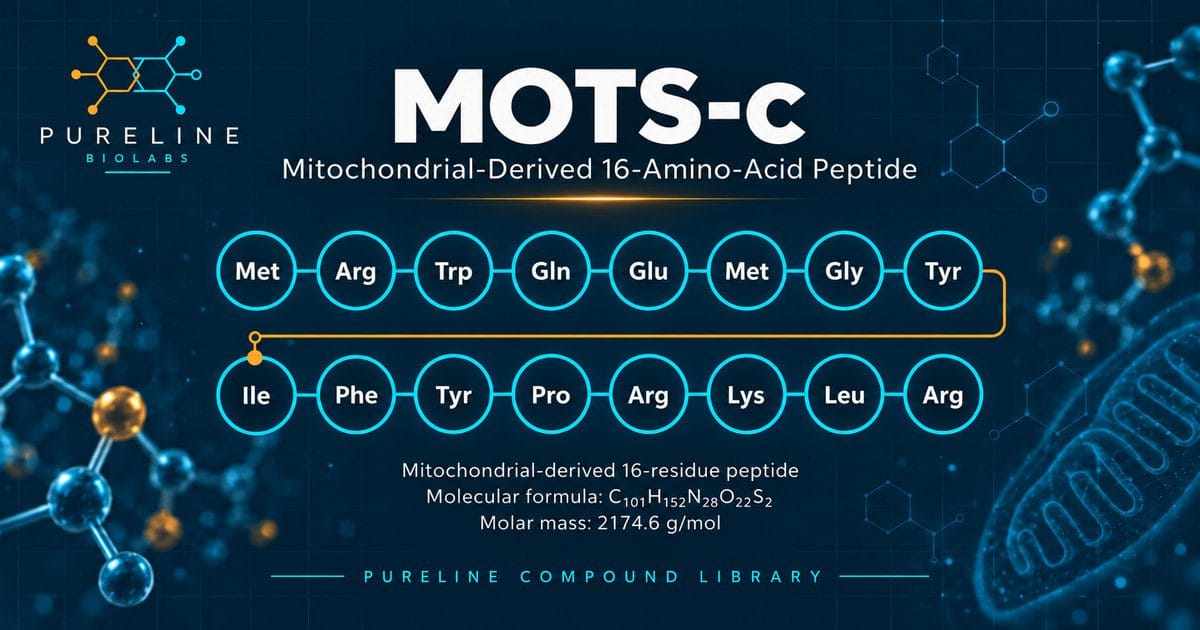
MOTS-c is a 16-amino-acid mitochondrial-derived peptide with the sequence Met-Arg-Trp-Gln-Glu-Met-Gly-Tyr-Ile-Phe-Tyr-Pro-Arg-Lys-Leu-Arg, abbreviated MRWQEMGYIFYPRKLR. Researchers first described it in 2015 as a peptide encoded by a short open reading frame within the mitochondrial 12S rRNA region, MT-RNR1.
Cell studies have examined MOTS-c in metabolic-stress signalling, folate and purine metabolism, AMPK-associated responses and communication between mitochondria and the nucleus. Animal studies have examined glucose metabolism, insulin sensitivity and physical performance. Human studies have mainly measured naturally produced MOTS-c or examined genetic associations. No published trial has administered synthetic MOTS-c to people, so the literature does not establish the safety or effect of doing so.
Pureline Biolabs supplies MOTS-c as a laboratory research material only. Published papers describe MOTS-c under their own experimental conditions. Pureline's independent batch report concerns the submitted sample from the stock Pureline holds. One cannot substitute for the other.
Chemical Identity
| Field | Information |
|---|---|
| Standard name | MOTS-c |
| Name expanded | Mitochondrial open reading frame of the 12S rRNA type-c |
| Sequence | Met-Arg-Trp-Gln-Glu-Met-Gly-Tyr-Ile-Phe-Tyr-Pro-Arg-Lys-Leu-Arg |
| One-letter sequence | MRWQEMGYIFYPRKLR |
| Peptide length | 16 amino-acid residues |
| Peptide class | Mitochondrial-derived peptide |
| Encoding region | Short open reading frame within mitochondrial 12S rRNA, MT-RNR1 |
| Molecular formula | C101H152N28O22S2 |
| Molar mass | 2174.6 g/mol |
| CAS number | 1627580-64-6 |
| PubChem CID | 146675088 |
| First described | 2015 |
| Research categories | Mitochondrial signalling, metabolic stress, AMPK, skeletal-muscle models and exercise biology |
| Form supplied by Pureline | Lyophilised laboratory research material |
| Pureline classification | For laboratory research use only. Not for human consumption or veterinary use. |
For general laboratory handling principles, see the Pureline Biolabs peptide reconstitution guide and reconstitution calculator.
PubChem records the neutral MOTS-c peptide as C101H152N28O22S2 with a molecular weight of 2174.6 g/mol.[2] An acetate salt, hydrate or material with other associated components can have a different total composition. The tested form should be stated in the batch documentation.
Why MOTS-c Has an Unusual Coding Origin
Most familiar peptides are translated from genes in nuclear DNA. MOTS-c was reported from a short open reading frame inside the mitochondrial 12S ribosomal RNA region.[1] This makes it part of the mitochondrial-derived peptide group, which also includes humanin and the small humanin-like peptides.
There is an important technical detail. The proposed MOTS-c sequence is viable when the nucleotide region is read using the standard genetic code. Reading the same region with the mammalian mitochondrial code produces stop codons. That observation led to the proposal that cytosolic translation is involved, but the exact processing and translation route remains an open research question rather than a settled fact.
The expanded name is commonly written as mitochondrial open reading frame of the 12S rRNA type-c. Both MOTS-c and MOTS-C appear in searches, but MOTS-c matches the form used in the original literature.
Evidence by Research Level
MOTS-c research spans chemical records, cultured cells, animal models and human observational work. Each level answers a different question, and the difference between measuring the peptide and administering it matters more here than for most compounds.
Chemical and Molecular Characterisation
MOTS-c has a defined 16-residue sequence and a calculated neutral molecular mass. These reference values can support analytical comparison. A matching intact mass alone does not prove complete sequence order, purity, quantity, sterility or biological activity.
The original 2015 report identified the short open reading frame within the 12S rRNA, detected MOTS-c in cells and circulation, and investigated its metabolic activity.[1] Later work studied its movement from the cytoplasm to the nucleus during metabolic stress.[3] These findings concern the biological peptide and the stated experimental systems, not a retail batch.
In-Vitro Research
The 2015 study reported that MOTS-c inhibits the folate cycle and its tethered de novo purine biosynthesis, and that this inhibition leads to activation of AMPK.[1] The authors also reported changes in glucose use in cellular models.
A 2018 study reported that metabolic stress caused MOTS-c to move into the nucleus in an AMPK-dependent manner, where it interacted with stress-responsive transcription factors and changed expression of genes containing antioxidant response elements.[3] This supports a proposed role in communication between mitochondrial and nuclear systems. It does not establish a complete human mechanism.
Animal Research
In mice, MOTS-c treatment was reported to protect against age-dependent and high-fat-diet-induced insulin resistance and to prevent diet-induced obesity under the tested conditions.[1] A later study reported changes in physical performance and skeletal-muscle metabolism in mice at 2, 12 and 22 months of age.[4]
These were controlled animal experiments using specified strains, routes, amounts and schedules. They cannot establish an effective or safe human use, and they do not validate the quality of a separately manufactured vial.
Human Research
The 2021 exercise study included ten sedentary healthy young men, mean age 24.5 years, and measured naturally produced MOTS-c before, during and after stationary cycling. The researchers reported higher MOTS-c measurements in skeletal muscle and circulation following exercise.[4]
This distinction is the most important one on the page. In that paper MOTS-c was measured in the human participants; it was not given to them. Every experiment in which MOTS-c was administered and performance was assessed was carried out in mice. Other human papers have examined circulating MOTS-c concentrations and mitochondrial genetic variants.[5,6] Those studies can identify associations or measured responses. They do not show that administering synthetic MOTS-c produces the same result, and they supply no clinical safety data for Pureline's material.
Evidence Summary
| Research level | What has been studied | Main limit |
|---|---|---|
| Chemical identity | Sequence, formula, molar mass and proposed mitochondrial coding region | Does not establish biological activity or batch quality |
| Cell and molecular work | Folate-purine pathways, AMPK, metabolic stress and nuclear translocation | Model-specific findings do not establish a human effect |
| Animal work | Glucose handling, insulin sensitivity, metabolic models and physical performance in mice | Animal results cannot define human safety or effectiveness |
| Human research | Endogenous levels during exercise, circulating concentrations and genetic associations | Observational or measurement-based; no trial has administered synthetic MOTS-c to people |
| Pureline batch analysis | Reported purity and quantity of the submitted stock sample | Does not establish safety, effectiveness, sterility or uniformity across every vial |
What Is Not Established
No paper cited here has tested Pureline Biolabs' current MOTS-c batch for a biological or clinical outcome. General MOTS-c research cannot certify a particular retail vial.
The available evidence does not establish
- That MOTS-c is an approved medicine in the United Kingdom
- That synthetic MOTS-c has a proven treatment, weight-loss, exercise or longevity effect in humans
- That an exercise-related rise in endogenous MOTS-c predicts the effect of administering synthetic peptide
- That findings from cultured cells or mice will occur in people
- That Pureline's research material matches any preparation used in a published experiment
- That HPLC purity proves identity, exact vial amount, sterility or endotoxin status
- That one submitted sample certifies every vial or any later batch
- That a laboratory report makes material suitable for human or animal administration
Limitations worth knowing
- Every intervention finding cited here comes from a cell or animal model
- Human exercise data in the key 2021 paper came from ten sedentary healthy young men
- Measurements of endogenous MOTS-c are not trials of synthetic MOTS-c administration
- Association studies cannot show that MOTS-c caused the measured outcome
- The biological meaning of circulating MOTS-c concentrations remains under study
- AMPK activation is model and condition dependent, not a guaranteed property in every system
- The exact translation and processing route for the mitochondrial short open reading frame is still being studied
- MOTS-c and humanin are separate mitochondrial-derived peptides with different sequences
- Formula and mass can vary when salts, water or other associated components are included
- HPLC peak-area purity does not measure exact vial quantity
- Intact-mass analysis supports identity but does not prove every structural feature
- Stability depends on peptide form, moisture, container closure, temperature, light and time
What Pureline Biolabs Independently Adds
First-party evidence
Many MOTS-c pages repeat proposed benefits without separating cell, animal and human evidence. Pureline adds product-specific records that the general literature cannot provide: the batch code shown on the vial, the independent analytical laboratory, the laboratory task number and direct verification key, the reported results, links connecting the product, the report and the current batch record, and a cold-chain record covering storage and handling while the stock remained under Pureline's control.
This lets a reader separate the published identity and research history of MOTS-c from the measured characteristics of Pureline's submitted batch sample.
Current Pureline Batch
The values above are taken from the Janoshik report for the sample submitted from batch PLB-008. The reported amount of 11.23mg is above the 10mg labelled vial size; Pureline publishes the measured figure rather than the label figure, in either direction. This certificate reports quantity and chromatographic purity. It does not report a separate sterility, endotoxin or sequence-confirmation result, and none should be inferred from it. The panel is updated when Pureline changes to a new batch, and earlier reports are kept under their original batch codes rather than replaced.
The Pureline Testing Standard
What a MOTS-c batch record should contain
- HPLC to report relative chromatographic peak-area purity
- Mass spectrometry to test consistency with the expected molecular mass
- Quantity analysis when the vial amount is presented as independently measured
- A visible batch code linking the vial to the report
- The laboratory task number and direct verification link
- Separate sterility, endotoxin or heavy-metal results only when those tests were commissioned for that batch
Testing Methods Explained
| Method | What it shows | What it does not show by itself |
|---|---|---|
| HPLC | Relative chromatographic peak-area purity under the stated method | Full identity, exact vial amount, sterility or endotoxin level |
| LC-MS | Whether detected mass data are consistent with the expected MOTS-c molecule | Complete sequence proof, exact quantity, sterility or biological activity |
| Quantity analysis | Amount of target material measured in the submitted sample | Purity, sterility, safety or clinical effect |
| Peptide mapping or fragmentation | Extra sequence information, depending on method and coverage | Automatic proof of every structural or stereochemical feature |
| Endotoxin test | Bacterial endotoxin level under the named method | Chemical identity or general sterility |
| Sterility test | Microbial growth under defined test conditions | Chemical purity, identity or suitability for administration |
A 99 per cent HPLC result means that about 99 per cent of the detected chromatographic peak area was assigned to the target peak under that method. It does not mean the vial is 99 per cent correctly filled, 99 per cent sterile or 99 per cent safe.
Storage and Traceability
Pureline stores MOTS-c according to the conditions printed on its label and batch documentation. The cold-chain log records storage and handling while the material remains under Pureline's control. It does not replace analytical testing or prove that no degradation occurred.
Stability depends on the material form, residual moisture, container closure, temperature, light and time. A general storage statement cannot provide a validated shelf life for every preparation.
Common Questions
What is MOTS-c peptide?
MOTS-c is a 16-amino-acid mitochondrial-derived peptide first described in 2015. Its sequence is MRWQEMGYIFYPRKLR, and its proposed coding region lies within mitochondrial 12S rRNA.
What does MOTS-c stand for?
MOTS-c stands for mitochondrial open reading frame of the 12S rRNA type-c. The literature usually styles the name as MOTS-c, while searches also commonly use MOTS-C.
What is the MOTS-c peptide sequence?
The full sequence is Met-Arg-Trp-Gln-Glu-Met-Gly-Tyr-Ile-Phe-Tyr-Pro-Arg-Lys-Leu-Arg. Its one-letter code is MRWQEMGYIFYPRKLR.
What are the MOTS-c molecular formula and molecular weight?
PubChem records the neutral peptide as C101H152N28O22S2 with a molecular weight of 2174.6 g/mol. Salt and hydrate forms can have a different total composition.
Is MOTS-c made by mitochondria?
MOTS-c is described as mitochondrially encoded because its proposed short open reading frame lies within mitochondrial DNA. The sequence depends on the standard genetic code rather than the mammalian mitochondrial code, so the exact translation route remains a subject of research.
What does research say about MOTS-c and AMPK?
The original study reported that MOTS-c inhibits the folate cycle and its tethered de novo purine biosynthesis, and that this leads to AMPK activation. A later study reported that MOTS-c moves into the nucleus in an AMPK-dependent manner under metabolic stress. Both findings come from defined experimental conditions and support a research pathway, not a proven clinical action in people.
Has MOTS-c been studied in humans?
Yes, but the distinction matters. Human research has measured naturally produced MOTS-c during exercise and examined circulating levels or genetic associations. No published study has administered synthetic MOTS-c to people. In the 2021 exercise paper, the participants were measured, not dosed; the administration experiments in that same paper were carried out in mice.
Is MOTS-c proven for weight loss, exercise performance or longevity?
No human therapeutic conclusion follows from the cited research. Common claims in these areas rest on cell studies, mouse experiments, measurements of endogenous MOTS-c or genetic associations, none of which test the administration of synthetic peptide to people.
What is the difference between endogenous and synthetic MOTS-c?
Endogenous MOTS-c is the peptide measured in biological systems. Synthetic MOTS-c is manufactured as a separate research material. Sharing a target sequence does not show that a synthetic batch has the same context, handling, purity or biological behaviour as peptide produced within a living system.
Is MOTS-c the same as humanin?
No. Both are grouped as mitochondrial-derived peptides, but they have different sequences, coding regions and research histories.
How is Pureline Biolabs MOTS-c tested?
Pureline submits a sealed sample from each batch to Janoshik Analytical before release. For batch PLB-008 the laboratory reported 98.123 per cent purity and a measured amount of 11.23mg under task number 209942, and the report can be checked directly through the verification link in the batch record above.
What does a MOTS-c Certificate of Analysis prove?
It supports only what the listed methods measured in the submitted sample. Purity and quantity results do not establish clinical safety, effectiveness, sterility, endotoxin level or suitability for administration.
Where can I verify Pureline's MOTS-c batch?
Match the batch code on the vial with the live record on this page, then follow the direct laboratory-verification link. Check Pureline's cold-chain log separately for the storage record connected to that stock.
References
- Lee C, Zeng J, Drew BG, et al. The mitochondrial-derived peptide MOTS-c promotes metabolic homeostasis and reduces obesity and insulin resistance. Cell Metab. 2015;21(3):443-454. PubMed 25738459
- National Center for Biotechnology Information. MOTS-c. PubChem CID 146675088. PubChem
- Kim KH, Son JM, Benayoun BA, Lee C. The mitochondrial-encoded peptide MOTS-c translocates to the nucleus to regulate nuclear gene expression in response to metabolic stress. Cell Metab. 2018;28(3):516-524.e7. PubMed 29983246
- Reynolds JC, Lai RW, Woodhead JST, et al. MOTS-c is an exercise-induced mitochondrial-encoded regulator of age-dependent physical decline and muscle homeostasis. Nat Commun. 2021;12:470. Nature Communications
- Ramanjaneya M, Bettahi I, Jerobin J, et al. Lipids and insulin regulate mitochondrial-derived peptide MOTS-c in humans. Endocrine. 2019;64(3):466-475. PubMed 31066084
- Fuku N, Pareja-Galeano H, Zempo H, et al. The mitochondrial-derived peptide MOTS-c: a player in exceptional longevity? Aging Cell. 2015;14(6):921-923. PMC4693465
All products sold by Pureline Biolabs Ltd are intended strictly for laboratory research purposes only. Not approved for human consumption, veterinary use, or any other application. Not evaluated by the MHRA or any other regulatory authority. Pureline Biolabs Ltd · Company No. 17236739 · purelinebiolabs.com