Nicotinamide Adenine Dinucleotide — more commonly known as NAD+ — has become one of the most intensely researched molecules in modern biology. Present in every living cell, this essential coenzyme plays a fundamental role in cellular energy metabolism and has attracted extraordinary scientific interest for its apparent role in ageing biology, DNA repair mechanisms and metabolic function.
What Is NAD+?
NAD+ is a coenzyme found in all living cells. It exists in two forms — NAD+ (the oxidised form) and NADH (the reduced form) — and cycles between these states as it transfers electrons in metabolic reactions. This electron transfer function makes NAD+ absolutely central to cellular respiration and energy production.
Beyond its role in energy metabolism, NAD+ serves as a substrate for several critically important enzyme families including sirtuins, PARP enzymes and CD38. These enzymes consume NAD+ as part of their biological functions, meaning that cellular NAD+ levels directly influence their activity.
NAD+ levels in human cells decline significantly with age, dropping by approximately 50% between the ages of 40 and 60 according to multiple research studies. This decline has attracted enormous scientific interest as a potential contributing factor to age related biological changes.
NAD+ and Sirtuin Research
Sirtuins are a family of seven proteins that regulate numerous cellular processes including gene expression, DNA repair, metabolism and stress responses. All seven sirtuins require NAD+ as a substrate to function.
Research has established that sirtuin activity is directly coupled to cellular NAD+ availability. When NAD+ levels are high, sirtuin activity increases. When NAD+ levels decline — as they do with ageing — sirtuin activity falls correspondingly.
This relationship has made NAD+ supplementation research a major area of longevity biology investigation. Studies in animal models have consistently demonstrated that restoring NAD+ levels can reactivate sirtuin function, with downstream effects on multiple biological systems.
NAD+ and PARP Enzymes
Poly ADP-ribose polymerases — PARP enzymes — are another major consumer of cellular NAD+. PARPs play a critical role in detecting and repairing DNA damage, consuming NAD+ in the process of building poly ADP-ribose chains that signal and coordinate the repair response.
As cells age and DNA damage accumulates, PARP activity increases to manage the mounting repair burden. This increased PARP activity consumes more NAD+, further depleting cellular stores and creating a cycle that researchers have identified as a potentially significant contributor to the biology of ageing.
NAD+ and Mitochondrial Function
NAD+ is absolutely essential to mitochondrial function. The electron transport chain — the primary mechanism by which cells generate ATP energy — depends on the NADH to NAD+ conversion to drive electron transfer between complexes.
Research has shown that declining NAD+ levels impair mitochondrial function, reducing cellular energy production capacity. Studies in aged animal models have demonstrated that restoring NAD+ levels can improve mitochondrial efficiency and increase cellular energy output.
Research Methods and Models
NAD+ research employs a wide range of laboratory methodologies. In vitro studies examine NAD+ metabolism in cell culture models, measuring changes in NAD+ levels, sirtuin activity, mitochondrial function and gene expression in response to various interventions.
Animal model research has been particularly productive in NAD+ biology. Studies in mice and other model organisms have examined the effects of NAD+ precursor supplementation on lifespan, metabolic function, cognitive performance and physical capacity, with many studies reporting significant positive findings.
Human clinical research is now advancing rapidly, with multiple clinical trials examining NAD+ precursors including NMN and NR in human subjects. Results from early trials have demonstrated that oral supplementation can effectively raise NAD+ levels in human blood and muscle tissue.
Physical Properties and Storage
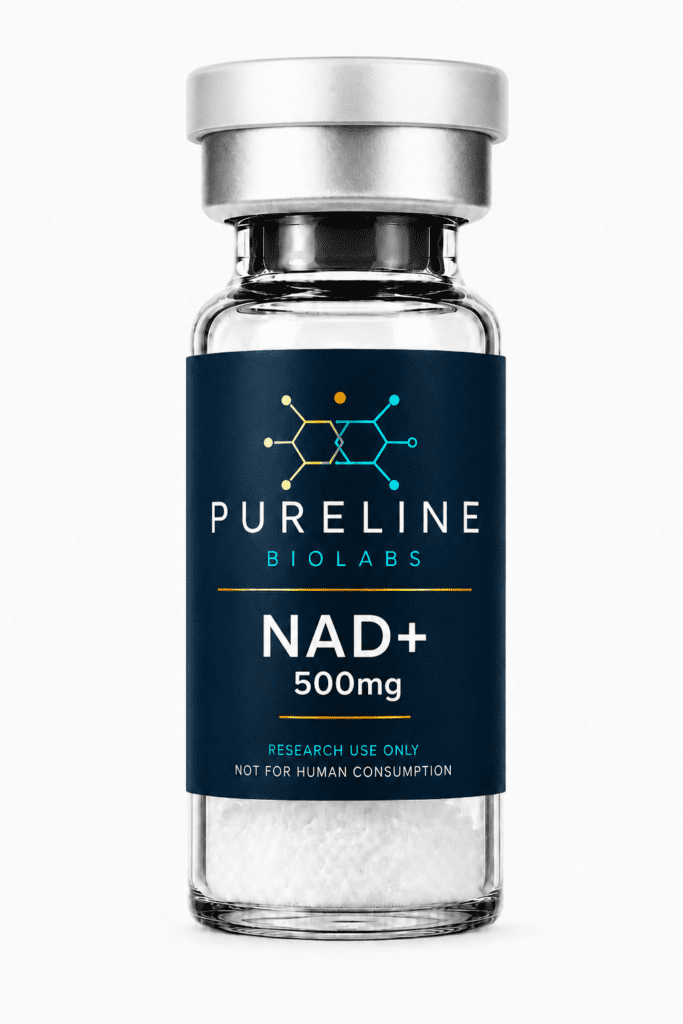
NAD+ is a significantly larger and more complex molecule than typical research peptides, with a molecular weight of approximately 663 Da. In its pure form it presents as a white to off-white crystalline powder with good water solubility.
NAD+ powder should be stored at 2-8°C for short term use and -20°C for long term storage. It is hygroscopic — meaning it readily absorbs moisture from the air — so storage in sealed, desiccated conditions is important. Protection from light is also recommended as NAD+ can degrade under UV exposure.
Quality Verification
NAD+ purity verification uses standard HPLC methodology. A quality Certificate of Analysis should confirm purity at minimum 99% with mass spectrometry confirmation of the molecular weight at approximately 663 Da.
At Pureline Biolabs our NAD+ is independently tested by Janoshik Analytical with a minimum specification of 99% purity. Every vial carries a unique QR code linking to the live publicly accessible certificate for that specific batch.
Legal Status in the UK
NAD+ is not a licensed medicine in the United Kingdom. As a naturally occurring coenzyme it occupies a different regulatory position to synthetic peptides. For laboratory research purposes it is freely available for purchase and use. Pureline Biolabs supplies NAD+ exclusively for in vitro laboratory research purposes.
Important Disclaimer
All products supplied by Pureline Biolabs Ltd are intended solely for in vitro laboratory research purposes. They are not medicines, not approved for human or veterinary use, and not for human consumption. Researchers are responsible for ensuring compliance with all applicable regulations in their jurisdiction.