GHK-Cu Peptide: Research Evidence and Batch Verification
GHK-Cu is a coordination complex formed between the naturally-occurring tripeptide glycyl-L-histidyl-L-lysine (GHK) and a copper(II) ion. It has been studied in chemical, cell-culture, animal and a small human cosmetic-formulation trial for its role in tissue remodelling. Findings from one research level should not be assumed to apply to another. Pureline Biolabs publishes independent, batch-specific analytical results for the stock it holds, rather than relying on the general literature to stand in for its own product.
Identity
| Field | Information |
|---|---|
| Standard name | GHK-Cu |
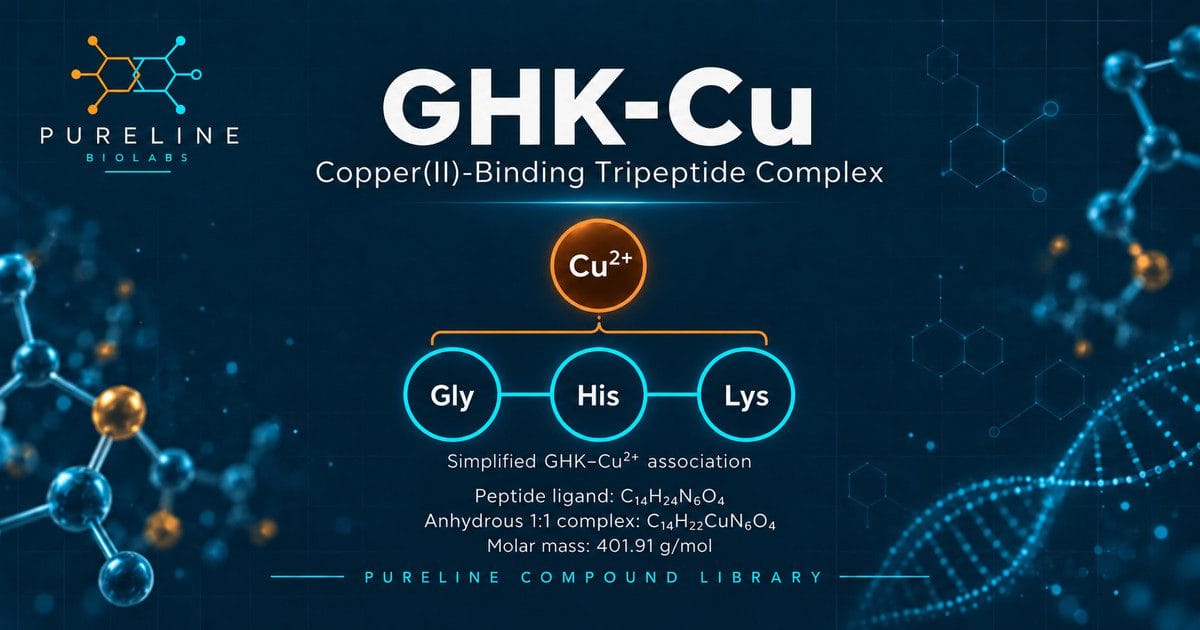
| Peptide ligand | Glycyl-L-histidyl-L-lysine |
| Sequence | Gly-His-Lys |
| Metal ion | Copper(II), Cu²⁺ |
| Common synonym | Copper tripeptide-1 |
| GHK ligand formula | C₁₄H₂₄N₆O₄ |
| Ligand molar mass | 340.38 g/mol (free GHK tripeptide) |
| Complex formula | Varies with protonation state and the representation used. The 1:1 complex is commonly written C₁₄H₂₂CuN₆O₄, approximately 401.9 g/mol. |
| CAS number | 89030-95-5 (GHK-Cu copper complex) and 49557-75-7 (free GHK ligand) |
| PubChem CID | 73587 for the free GHK ligand. PubChem holds several separate records for the copper complex, differing in stoichiometry and protonation state, so no single CID is cited here. |
| First identified | Plasma activity reported 1973; GHK sequence identified 1977 [2,3] |
| Research categories | Coordination chemistry, extracellular matrix biology, oxidative stress models |
| Pureline classification | Supplied solely as a laboratory research material. Not intended for human, veterinary, cosmetic or dietary use. |
For general laboratory handling principles, see the Pureline Biolabs peptide reconstitution guide and reconstitution calculator.
Copper Coordination
GHK-Cu's copper-binding behaviour has been characterised through direct coordination studies. Copper(II) coordination involves several donor groups within GHK, including the N-terminal amino group, a deprotonated peptide-bond nitrogen and the imidazole nitrogen of histidine. The exact coordination description can vary with pH and experimental conditions [1].
Evidence by Research Level
Not all GHK-Cu findings carry equal weight. Grading the evidence by the type of model it came from is more useful than treating every published result as equivalent.
| Evidence area | Model | Source | Main limitation |
|---|---|---|---|
| Copper coordination | Chemical solution study | Bossak et al., 2014 [1] | Does not measure biological activity |
| Matrix & MMP biology | Human fibroblast culture | Badenhorst et al., 2016 [6] | Isolated cell-culture model |
| Wound research | Rodent & rabbit models | Reviewed in Pickart et al. [7] | Animal findings may not translate to humans |
| Cosmetic formulation | 40 female volunteers | Badenhorst et al., 2016 [6] | Small topical-formulation study |
Animal Research
Animal wound models have reported changes in wound closure, local blood-vessel formation, antioxidant-enzyme activity, and selected inflammatory or matrix-remodelling markers following GHK-Cu application to induced wounds. Reported findings vary by species, wound model, formulation and method of administration [7].
Human Research
One published randomised, double-blind study involved 40 women aged 40 to 65 and evaluated twice-daily topical application of GHK-Cu in a lipid-based nanocarrier over eight weeks. The study included a vehicle serum and a commercial Matrixyl 3000 product as comparators, and reported differences in measured wrinkle volume and depth [6]. This was a small cosmetic-formulation study, not an investigation of lyophilised laboratory material or an injectable preparation. Its findings cannot establish effects for other formulations, concentrations or applications.
Not Established
No published human research has evaluated Pureline's specific GHK-Cu batch, its intended laboratory applications, or any outcome relevant to human or animal treatment. Findings from topical cosmetic formulations, cell cultures, or animal wound models do not establish that any particular effect would occur with a different formulation, concentration, or route.
Limitations Worth Knowing
- Studies use varying formulations and concentrations, which are not directly comparable to each other
- GHK and GHK-Cu are chemically related but not interchangeable in their reported effects
- Findings from cosmetic-carrier trials cannot be assumed to apply to other preparations
- HPLC purity as a percentage does not by itself establish exact quantity, sterility, or endotoxin status
- Storage stability depends on solvent, pH, temperature, concentration and light exposure — conditions vary between studies
- Most available evidence comes from cellular or animal models, not human data
- A published study describes that specific experiment — it does not certify the performance of any particular retail batch
Current Pureline Batch
GHK content and copper content figures are taken directly from the laboratory's own report for this batch. This panel reflects the batch currently listed for sale and is updated when stock changes.
Testing Methods Explained
| Method | What it actually shows |
|---|---|
| HPLC | Relative peak areas detected under the stated chromatographic method. Does not determine absolute vial quantity by itself. |
| Mass Spectrometry | Provides molecular-mass and isotope-pattern evidence that supports the assigned identity. Results depend on the method, ionisation conditions and interpretation. |
| Quantity Analysis | Measures the amount of assigned target material in the submitted sample using a separate quantitative method. |
| Endotoxin Testing | Measures bacterial endotoxin under the stated method. Does not establish sterility. |
| Sterility Testing | Tests for microbial growth under defined conditions and for the stated incubation period. |
A "99% pure" figure reports the relative areas of detected chromatographic peaks for that sample under the laboratory's stated method. HPLC alone cannot prove that a particular peak is GHK-Cu without supporting identity work — which is why identity and purity are tested and reported separately.
Common Questions
Is the copper in GHK-Cu the same as dietary copper?
Copper is the same chemical element in both contexts, but its chemical behaviour depends on its oxidation state and the molecules to which it is bound. GHK-Cu specifically describes copper coordinated by glycyl-L-histidyl-L-lysine. It should not be treated as equivalent to every form of copper present in food, supplements or biological tissue.
Does the human trial mean GHK-Cu is proven to work?
One published randomised trial exists for a specific cosmetic nanocarrier formulation, tested in 40 women over an eight-week period. It does not establish an effect for any other formulation, concentration, or application, and does not extend to laboratory research use.
How is GHK-Cu different from KPV as a research compound?
GHK-Cu is a copper-coordinating tripeptide investigated in coordination chemistry and experimental models involving extracellular-matrix biology. KPV is an alpha-MSH-derived tripeptide with no equivalent metal-binding role, investigated in laboratory and animal models involving inflammatory signalling and intestinal-barrier function. The compounds have different sequences, chemical properties, and research literatures.
What does a 99.700% purity figure actually confirm?
It reports the relative areas of detected chromatographic peaks for that sample under Janoshik's stated HPLC method. The PLB-013 report separately provides GHK content, copper content and mass-spectrometry identity data. It does not report sterility or endotoxin testing.
References
- Bossak K, et al. Formation constants of copper(II) complexes with tripeptides containing Glu, Gly, and His. Inorg Chem. 2014;53(3):1278-1287. DOI: 10.1021/ic4009575
- Pickart L, Thaler MM. Tripeptide in human serum which prolongs survival of normal liver cells and stimulates growth in neoplastic liver. Nature New Biol. 1973;243(124):85-87. PubMed 4349963
- Schlesinger DH, Pickart L, Thaler MM. Growth-modulating tripeptide is H-Gly-His-Lys-OH. Experientia. 1977;33:324-325.
- Pickart L. The human tri-peptide GHK and tissue remodeling. J Biomater Sci Polym Ed. 2008. PubMed 18644225
- Pickart L, Vasquez-Soltero JM, Margolina A. GHK Peptide as a Natural Modulator of Multiple Cellular Pathways in Skin Regeneration. Biomed Res Int. 2015. DOI: 10.1155/2015/648108
- Badenhorst T, Svirskis D, Merrilees M, Bolke L, Wu Z. Effects of GHK-Cu on MMP and TIMP Expression, Collagen and Elastin Production, and Facial Wrinkle Parameters. J Aging Sci. 2016;4:166. DOI: 10.4172/2329-8847.1000166
- Pickart L, Margolina A. Regenerative and Protective Actions of the GHK-Cu Peptide in the Light of the New Gene Data. Int J Mol Sci. 2018;19(7):1987. PMC6073405
All products sold by Pureline Biolabs Ltd are intended strictly for laboratory research purposes only. Not approved for human consumption, veterinary use, or any other application. Not evaluated by the MHRA or any other regulatory authority. Pureline Biolabs Ltd · Company No. 17236739 · purelinebiolabs.com