


KPV Peptide: Sequence, Research Evidence and Batch Testing
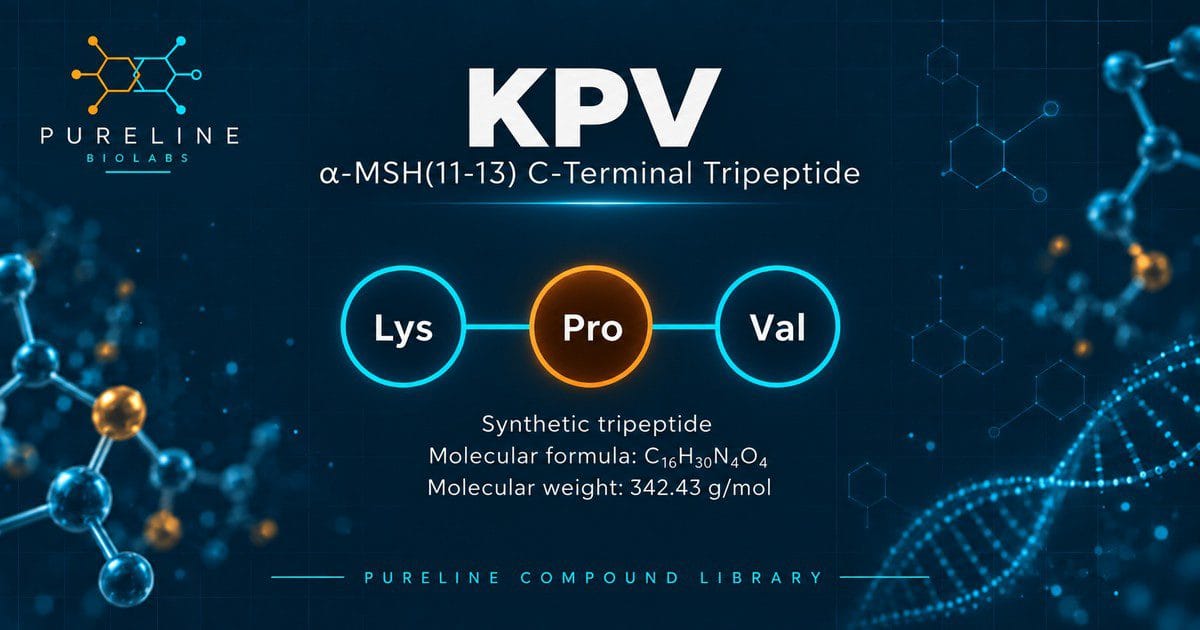
KPV is a short tripeptide with the amino-acid sequence lysine-proline-valine. It corresponds to positions 11 to 13 at the C-terminal end of alpha-melanocyte-stimulating hormone, commonly written as alpha-MSH(11-13).
Researchers have examined KPV in cellular and animal models involving inflammatory signalling, intestinal epithelial transport, experimental colitis and immune-cell migration. Published KPV research is almost entirely preclinical. No controlled human clinical trial establishing the safety or efficacy of isolated KPV was identified for this page. Results from cell cultures and animal models cannot establish a treatment effect, a suitable application or a safety profile in humans.
Pureline Biolabs supplies KPV as a laboratory research material and publishes independent, batch-specific analytical results for the stock it holds. The general KPV literature does not certify the identity, purity or quantity of any individual retail batch.
Chemical Identity
| Field | Information |
|---|---|
| Standard name | KPV |
| Full sequence name | L-lysyl-L-prolyl-L-valine |
| Amino-acid sequence | Lys-Pro-Val |
| One-letter sequence | KPV |
| Structural notation | H-Lys-Pro-Val-OH |
| Peptide length | Three amino-acid residues |
| Related peptide | C-terminal sequence of alpha-MSH |
| Alternative name | alpha-MSH(11-13) |
| Molecular formula | C16H30N4O4 |
| Molecular weight | 342.43 g/mol |
| CAS number | 67727-97-3 |
| PubChem CID | 125672 |
| Research categories | Intestinal epithelial signalling, inflammatory models, immune-cell migration |
| Form supplied | Lyophilised powder in a sealed research vial |
| Pureline storage condition | Refrigerated at 2-8°C, protected from light and moisture |
| Pureline classification | Laboratory research material only. Not a medicine, cosmetic or supplement in the UK. |
For general laboratory handling principles, see the Pureline Biolabs peptide reconstitution guide and reconstitution calculator.
The molecular weight above can be checked directly from the sequence. Lysine, proline and valine have residue masses of 146.19, 115.13 and 117.15 g/mol; condensing three amino acids into a tripeptide removes two water molecules, giving 378.47 minus 36.03, or 342.44 g/mol.[1] Salt forms, counterions, water content and protonation state can change the formula weight reported for a supplied preparation, so the material description on the analytical report should be compared rather than relying only on a general database entry.
What KPV Is, and What It Is Not
KPV takes its name directly from the one-letter abbreviations of its three amino acids: lysine, proline and valine. The same sequence appears at positions 11 to 13 of alpha-MSH, a longer peptide involved in melanocortin biology.
KPV therefore shares a structural relationship with alpha-MSH, but the two should not be treated as interchangeable. Removing most of the parent peptide changes its receptor interactions, transport behaviour and biological context. A finding involving full-length alpha-MSH is not a KPV finding.
KPV research has attracted attention partly because such a short sequence can still influence inflammatory responses in certain experimental models. Its length also makes it a useful subject for studies of peptide transport, particularly through PepT1, the transporter that carries dipeptides and tripeptides across cell membranes.
Why the Lys-Pro-Val Sequence Matters
Each residue contributes different chemical properties. Lysine carries a basic side chain that can hold a positive charge under common experimental conditions. Proline introduces a rigid ring that restricts movement along the peptide backbone. Valine contributes a hydrophobic side chain at the C-terminal end.
Together these form the C-terminal KPV sequence found within alpha-MSH. Identifying the sequence does not by itself establish a biological result. Activity depends on the test model, concentration, formulation, exposure conditions and analytical method used.
Evidence by Research Level
Not every KPV finding carries the same weight. Separating evidence by model type prevents cellular observations being presented as established human outcomes.
In-Vitro Research
A 2008 study examined KPV in human intestinal epithelial cell lines and Jurkat T cells. It reported that nanomolar KPV reduced activation of NF-kappaB and MAP kinase signalling and reduced secretion of pro-inflammatory cytokines under the conditions tested. Transport experiments in the same study linked cellular uptake to PepT1.[3]
That finding relates to those specific cultured-cell systems. It does not show how a separate preparation would behave in a person. Other laboratory work has investigated KPV and related alpha-MSH fragments in immune, epithelial and microbial models. Modified peptides such as CKPV derivatives or KPV dimers are different test articles and should not be treated as equivalent to unmodified Lys-Pro-Val.
Animal Research
KPV has been examined in several mouse inflammation models. In DSS-induced and TNBS-induced colitis models, KPV added to drinking water was associated with lower inflammatory-marker expression and changes in histological measurements. Separate work using a T-cell transfer model reported reduced inflammatory changes following KPV treatment.[4]
A crystal-induced peritonitis study reported reduced accumulation of polymorphonuclear leukocytes after KPV administration, and indicated that KPV did not act in the same way as the central melanocortin receptor-binding sequence of alpha-MSH.[2]
These were controlled animal experiments using induced disease models. They do not establish an effect, a safe exposure level or a suitable route in humans.
Human Research
No controlled human clinical trial establishing the safety or efficacy of isolated KPV was identified in the literature reviewed for this page.
This distinction is worth stating plainly, because it is easily blurred. References in the literature to human intestinal cells, human immune cells or human bronchial cells describe laboratory cultures of human-derived cells. They do not mean that KPV was administered to human participants.
What Is Not Established
Published research has not established
- A licensed medical use for KPV
- A clinically proven human benefit
- A validated human dose or administration route
- Long-term human safety
- Equivalence between KPV and alpha-MSH
- Equivalence between unmodified KPV and CKPV derivatives
- Sterility or endotoxin status from a purity result
- The performance of any Pureline batch on the basis of general research papers
Pureline Biolabs does not present KPV as a treatment for inflammatory bowel disease, skin conditions, digestive disorders or any other medical condition.
Research limitations worth knowing
- Most published findings come from cell cultures or animal models
- Experimental colitis models do not reproduce every feature of human inflammatory bowel disease
- Studies use different concentrations, exposure periods and delivery systems
- Results involving alpha-MSH cannot automatically be assigned to KPV
- Modified compounds such as CKPV, KPV dimers and nanoparticle-bound KPV are chemically different test articles
- PepT1 expression varies between tissues, cell types and experimental conditions
- Reported changes in inflammatory markers do not establish a clinical outcome
- A research paper cannot verify the contents of a commercial vial
- Chromatographic area purity does not establish sterility, endotoxin level or exact vial quantity
Current Pureline Batch
The values above are taken from the Janoshik report for the sample submitted from batch PLB-011. Two points of accuracy are worth stating. First, the certificate reports a measured amount and a purity percentage; it does not state the analytical method by name, and it does not report a separate identity, sterility, endotoxin or sequence-confirmation result. None of those should be inferred from it. Second, the sample name field on the certificate reads KVP, a transposition of KPV; the tests-requested field and the results row on the same certificate both read KPV, and Pureline has asked the laboratory to correct the sample label. The measured amount of 9.82mg is below the 10mg labelled vial size. This panel is updated when Pureline changes to a new batch, and earlier reports are kept under their original batch codes rather than replaced.
What the Test Results Show
| Method | What it shows | What it does not show by itself |
|---|---|---|
| Chromatographic purity | The relative peak area assigned to the target compound under the stated test method | Exact vial amount, identity, sterility or endotoxin level |
| Quantity analysis | The amount of target material measured in the submitted sample | Purity, sterility, safety or clinical effect |
| Mass spectrometry | Whether detected mass data are consistent with the expected molecule | Complete sequence proof, exact quantity, sterility or biological activity |
| Endotoxin test | Bacterial endotoxin level under the named method | Chemical identity or general sterility |
| Sterility test | Microbial growth under defined test conditions | Chemical purity, identity or suitability for administration |
The certificate for batch PLB-011 covers the first two rows of that table only. Mass spectrometry, endotoxin and sterility testing were not commissioned for this batch, and the page makes no claim about them.
A 98.015 per cent purity result answers one narrow analytical question. It does not mean the vial is 98 per cent correctly filled, 98 per cent sterile or 98 per cent safe.
KPV Compared With Related Research Peptides
| Compound | Sequence and size | Relationship to KPV |
|---|---|---|
| alpha-MSH | 13 residues, interacts with the melanocortin receptor system | KPV is its C-terminal three residues. Different size, receptor interactions and experimental behaviour. An alpha-MSH finding is not a KPV finding. |
| GHK-Cu | Gly-His-Lys coordinated with copper(II), three residues | Same length, no close structural relationship. Appears mainly in extracellular matrix and copper-binding research rather than inflammatory signalling. |
| BPC-157 | 15 residues, separate sequence and research history | Unrelated. Results involving either compound cannot support claims about the other. |
Common Questions
What is the KPV amino-acid sequence?
The KPV peptide sequence is Lys-Pro-Val, representing lysine, proline and valine. Its one-letter amino-acid code is KPV.
Is KPV the same as alpha-MSH?
No. KPV corresponds to residues 11 to 13 of alpha-MSH, but alpha-MSH is a longer 13-residue peptide. The two differ in size, receptor interactions and experimental behaviour.
What does alpha-MSH(11-13) mean?
The notation identifies amino-acid positions 11, 12 and 13 of alpha-MSH. Those three C-terminal residues form the Lys-Pro-Val sequence called KPV.
What is the molecular formula of KPV?
The neutral free-peptide formula is C16H30N4O4, with a molecular weight of approximately 342.43 g/mol. That figure can be checked directly from the three residue masses. A salt form may have a different reported formula weight.
Does KPV act through melanocortin receptors?
The mechanism is model-dependent. Some experimental work suggests KPV can produce effects without the classical melanocortin receptor signalling associated with longer alpha-MSH sequences, and intestinal-cell research has linked KPV uptake to PepT1. That does not establish one universal mechanism across every tissue or model.
Has KPV been tested in humans?
Researchers have studied KPV in human-derived cell lines, which is not the same as a human clinical trial. No controlled clinical evidence establishing isolated KPV as a safe or effective human treatment was identified for this page.
Does a 98.015% purity result mean the vial is sterile?
No. A purity figure reports chromatographic composition under the stated method. Sterility and endotoxin levels require separate laboratory tests, and neither was commissioned for batch PLB-011.
Why does the Janoshik certificate say KVP rather than KPV?
The sample name field on the certificate for task 209945 contains a transposition. The tests-requested field and the results row on the same certificate both read KPV, so the analyte was correctly identified; the error is confined to the sample label. Pureline has asked the laboratory to correct it, and is publishing the certificate as issued rather than describing it differently from what it says.
How can I verify Pureline Biolabs KPV?
Match the PLB batch number printed on the vial with the entry in Pureline's batch records. You can then open the independent laboratory record and compare the task number, testing date and analytical results against what is published here.
References
- National Center for Biotechnology Information. MSH(11-13). PubChem CID 125672. PubChem
- Getting SJ, Schiöth HB, Perretti M. Dissection of the anti-inflammatory effect of the core and C-terminal KPV alpha-melanocyte-stimulating hormone peptides. J Pharmacol Exp Ther. 2003;306(2):631-637. PubMed 12750433
- Dalmasso G, Charrier-Hisamuddin L, Nguyen HTT, Yan Y, Sitaraman S, Merlin D. PepT1-mediated tripeptide KPV uptake reduces intestinal inflammation. Gastroenterology. 2008;134(1):166-178. PubMed 18061177
- Kannengiesser K, Maaser C, Heidemann J, et al. Melanocortin-derived tripeptide KPV has anti-inflammatory potential in murine models of inflammatory bowel disease. Inflamm Bowel Dis. 2008. PubMed 18092346
- Catania A, Gatti S, Colombo G, Lipton JM. Targeting melanocortin receptors as a novel strategy to control inflammation. Ann N Y Acad Sci. PMC2095288
All products sold by Pureline Biolabs Ltd are intended strictly for laboratory research purposes only. Not approved for human consumption, veterinary use, or any other application. Not evaluated by the MHRA or any other regulatory authority. Pureline Biolabs Ltd · Company No. 17236739 · purelinebiolabs.com