


Melanotan I (Afamelanotide): Structure, Research Evidence and Batch Testing
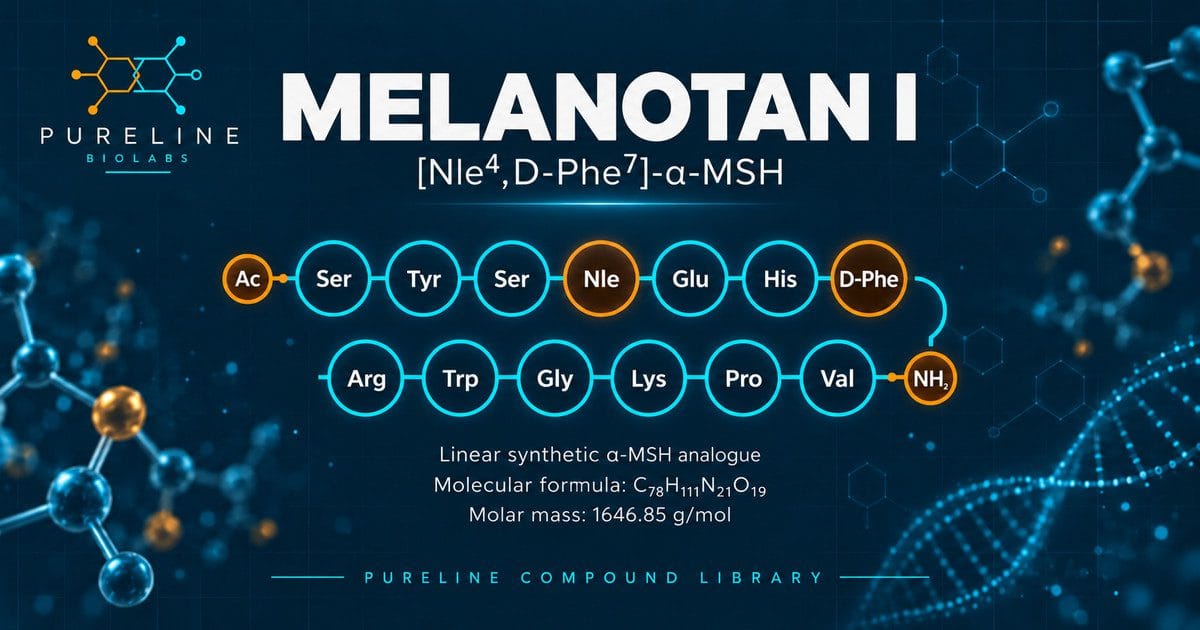
Melanotan I is a linear synthetic tridecapeptide derived from alpha-melanocyte-stimulating hormone, usually written as alpha-MSH. It is also known as afamelanotide, NDP-alpha-MSH and [Nle4,D-Phe7]-alpha-MSH. Compared with native alpha-MSH, the sequence contains norleucine at position 4 and D-phenylalanine at position 7. These substitutions produced an analogue with greater resistance to enzymatic breakdown and prolonged activity in early experimental systems.
The name requires care. Afamelanotide is also the active substance in Scenesse, a regulated 16 mg controlled-release implant used under specialist medical supervision for erythropoietic protoporphyria. A lyophilised Melanotan I research article is not the licensed implant, has not been assessed as an equivalent medicine, and must not borrow the implant's regulatory status or clinical evidence.
Pureline Biolabs supplies Melanotan I as a laboratory research material only. Pureline publishes batch-specific analytical results for the stock it holds rather than using general afamelanotide literature as evidence for the identity, purity or performance of a retail batch.
Chemical Identity
| Field | Information |
|---|---|
| Standard research name | Melanotan I |
| Pharmacological name | Afamelanotide |
| Common abbreviations | MT-1, NDP-MSH, NDP-alpha-MSH |
| Structural name | [Nle4,D-Phe7]-alpha-MSH |
| Peptide class | Linear synthetic alpha-MSH analogue |
| Sequence length | 13 amino-acid residues |
| Sequence | Ac-Ser-Tyr-Ser-Nle-Glu-His-D-Phe-Arg-Trp-Gly-Lys-Pro-Val-NH2 |
| Molecular formula | C78H111N21O19 |
| Molar mass | 1646.85 g/mol |
| CAS number | 75921-69-6 |
| PubChem CID | 16197727 |
| UNII | QW68W3J66U |
| Key structural changes | Met at position 4 replaced by Nle; L-Phe at position 7 replaced by D-Phe |
| Research categories | Melanocortin-receptor pharmacology, pigment-cell biology, photobiology |
| Pureline classification | Laboratory research material only. Not intended for human, veterinary, cosmetic or dietary use. |
For general laboratory handling principles, see the Pureline Biolabs peptide reconstitution guide and reconstitution calculator.
The formula and molar mass above describe the neutral peptide recorded in chemical databases.[1,2] Material supplied as an acetate salt, hydrate or another defined form may have a different total formula and mass. The batch documentation should state which material was analysed.
Why the Melanotan I Sequence Differs From Alpha-MSH
Native alpha-MSH and Melanotan I are both linear 13-residue peptides. They share the same N-terminal acetyl group, C-terminal amide and most of the same amino-acid sequence. The difference lies at two positions.
At position 4, norleucine replaces methionine. At position 7, D-phenylalanine replaces the naturally configured L-phenylalanine. The name [Nle4,D-Phe7]-alpha-MSH records those changes directly.
The original 1980 characterisation reported that this analogue resisted degradation by serum enzymes and produced stronger, longer-lasting activity than native alpha-MSH in the assays used at the time. In the mouse melanoma adenylate cyclase assay it was reported as 26 times as potent as alpha-MSH.[3] That result explains why the sequence became a widely used melanocortin-receptor research tool. It does not establish the quality or biological behaviour of any untested commercial vial.
Evidence by Research Level
Research findings should be read according to the model, formulation and question studied. Cell assays, animal models, early human pharmacology studies and trials of a regulated implant do not provide interchangeable evidence.
Chemical and Receptor Characterisation
Melanotan I was first reported in the research literature as the alpha-MSH analogue [Nle4,D-Phe7]-alpha-MSH. Early work examined serum-enzyme resistance, frog skin bioassay responses, mouse melanoma adenylate cyclase activation and tyrosinase stimulation.[3] Later receptor studies used NDP-alpha-MSH as a reference agonist when characterising melanocortin receptor systems.[4]
The His-Phe-Arg-Trp region within the alpha-MSH sequence forms a central melanocortin pharmacophore. Melanotan I retains this region, with D-Phe at position 7. Receptor activity does not mean that every biological effect observed in one cell system will occur in another model.
In-Vitro Research
Cell-based studies have examined NDP-alpha-MSH binding, receptor internalisation, cyclic AMP signalling, tyrosinase activity and pigment-cell responses. These experiments help researchers investigate melanocortin receptor biology under controlled conditions.[3,4]
An in-vitro response establishes activity in that particular assay. It does not establish clinical effectiveness, safety, dose equivalence or suitability for use in a person or animal.
Animal and Preclinical Research
Early preclinical work used amphibian skin and mouse melanoma cells to compare the duration and potency of Melanotan I with native alpha-MSH.[3] These models contributed to the compound's development as a melanocortin research probe.
Results from pigment cells or animal models cannot be treated as proof of a human result. Species, receptor expression, formulation, exposure and measured outcomes all differ.
Early Human Pharmacology Research
A randomised, double-blind, placebo-controlled study published in 1991 examined the pigmentary response to NDP-alpha-MSH in 28 healthy white men. Participants received ten subcutaneous injections of either the peptide preparation or saline over twelve days. The study reported statistically significant skin darkening in the active-treatment groups and no darkening in the placebo group, with peak pigmentation one to three weeks after treatment ended.[5]
A separate pharmacokinetic study compared intravenous, oral and subcutaneous administration. It reported a short plasma disposition phase, with beta-phase half-lives between roughly 0.8 and 1.7 hours after subcutaneous dosing, while tanning peaked around one week after dosing and was still present three weeks after the ten-dose regimen finished.[6] These early studies describe specific experimental preparations and protocols. They do not validate an online research product or establish unsupervised use as safe.
Controlled Clinical Evidence for the Afamelanotide Implant
Two multicentre, randomised, double-blind, placebo-controlled trials studied afamelanotide as a 16 mg subcutaneous controlled-release implant given every 60 days to people with erythropoietic protoporphyria. In the United States trial, 94 patients recorded a median 69.4 hours of pain-free sun exposure over six months against 40.8 hours on placebo. In the European Union trial, 74 patients recorded a median 6.0 hours over nine months against 0.8 hours on placebo.[7,8] The European Medicines Agency describes Scenesse as an implant for preventing phototoxicity in adults with EPP.[7]
This is evidence for a named pharmaceutical implant, manufactured and administered within a regulated medical system. It is not evidence for a lyophilised research vial, a different formulation, a cosmetic product or another route of administration.
Post-Authorisation Research
Observational research has continued to examine outcomes among patients receiving the authorised afamelanotide implant for EPP, including a German cohort study of short- and long-term safety and clinical effectiveness.[9] Such studies can add information about medical use in clinical practice, but they remain formulation-specific and indication-specific.
What Is Not Established
No published study has evaluated Pureline Biolabs' current Melanotan I batch for a biological or clinical outcome. A batch-specific HPLC or mass-spectrometry report does not establish medical effectiveness, cosmetic results, safety, sterility, endotoxin status or suitability for administration.
Claims that cannot be inferred from the literature or from a purity percentage
- That Pureline's lyophilised research material is equivalent to Scenesse
- That evidence from a controlled-release implant applies to a vial or another formulation
- That an HPLC result confirms molecular identity, exact amount, sterility or endotoxin level
- That an intact-mass result alone proves the D-configuration of phenylalanine at position 7
- That receptor activity predicts a safe or useful outcome in humans or animals
- That a report for one submitted sample certifies every vial or a later batch
Limitations worth knowing
- Melanotan I, afamelanotide and NDP-alpha-MSH usually refer to the same core peptide sequence, but finished products and formulations can differ substantially
- Scenesse is a controlled-release medicinal implant, not a general name for unlicensed lyophilised powder
- Published studies use different formulations, exposure schedules, populations and endpoints
- The 1991 human pigment study enrolled 28 healthy white men, so its findings should not be generalised across skin types or to women
- Melanocortin receptors occur in more than one tissue, so a receptor label does not describe every downstream response
- Molecular formula and molar mass can differ when an acetate counterion, water content or another material form is included
- HPLC peak-area purity does not show how much target peptide is present in a vial
- Routine intact-mass analysis supports molecular identity but does not independently prove sequence order or amino-acid stereochemistry
- Sterility and endotoxin status require separate, named tests
- Storage stability depends on the material form, water content, temperature, light exposure and time
The Pureline Testing Standard
Two separate forms of evidence
Pureline treats product testing and published research as two separate forms of evidence. Scientific papers describe the material and experiment used by their authors. Pureline's batch report addresses the sample submitted from its own stock.
Because Melanotan I contains D-phenylalanine, routine HPLC and intact-mass testing should not be described as direct proof of stereochemical configuration. The D and L forms share the same molecular mass.
Current Pureline Batch
About the reported amount
The reported amount for batch PLB-005 is 8.13mg, measured in the sample submitted to Janoshik Analytical. That is below the 10mg vial size printed on the label, and we are publishing it rather than omitting it.
Pureline has raised the difference with the testing laboratory and the supplier and will publish the explanation, and any corrective action, on this page. Lyophilised peptide supplied as an acetate salt carries counterion and residual water that are not target peptide, and that can account for part of a difference of this kind, but Pureline is not presenting that as the confirmed reason for this batch.
Researchers working with this batch should treat 8.13mg, not 10mg, as the measured quantity of Melanotan I in the tested sample. The reported purity of 99.805% describes chromatographic purity and is a separate measurement from quantity.
Testing Methods Explained
| Method | What it shows | What it does not show by itself |
|---|---|---|
| HPLC | Relative chromatographic peak-area purity under the stated method | Exact vial amount, full identity, sterility or endotoxin level |
| Mass spectrometry | Whether the detected mass is consistent with the expected molecule | D/L stereochemistry, full sequence order, sterility or exact quantity |
| Quantity analysis | How much target material the tested sample contains | Sterility, endotoxin status or biological activity |
| Peptide mapping or fragmentation analysis | Additional sequence information, depending on method and coverage | Automatic proof of every stereochemical feature |
| Endotoxin testing | Bacterial endotoxin level under the named method | General sterility or chemical purity |
| Sterility testing | Microbial growth under defined test conditions | Chemical identity, purity or clinical suitability |
A 99 per cent purity result answers one analytical question. It must not be presented as proof that a sample is 99 per cent safe, 99 per cent correctly dosed or suitable for administration.
Storage and Batch Traceability
Melanotan I storage statements should match the material form and the evidence supplied with the batch. Keep the lyophilised research material under the conditions printed on the Pureline label and batch documentation. Protecting peptide material from heat, moisture and prolonged light exposure reduces avoidable handling variation, but it does not create a validated shelf life.
Pureline's cold-chain record documents how stock was stored and handled while under Pureline's control. It complements the analytical report. It does not replace chemical testing or prove that no molecular change occurred.
Common Questions
What is Melanotan I?
Melanotan I is a linear 13-amino-acid synthetic analogue of alpha-MSH. It contains norleucine at position 4 and D-phenylalanine at position 7, giving the structural name [Nle4,D-Phe7]-alpha-MSH.
Is Melanotan I the same as afamelanotide?
The names usually refer to the same core peptide sequence. However, afamelanotide is also the pharmaceutical name used for the regulated Scenesse implant. A loose lyophilised research article is not equivalent to that implant and does not share its approval.
What is the Melanotan I peptide sequence?
The sequence is Ac-Ser-Tyr-Ser-Nle-Glu-His-D-Phe-Arg-Trp-Gly-Lys-Pro-Val-NH2. Ac shows N-terminal acetylation and NH2 shows C-terminal amidation.
What are the Melanotan I molecular formula and molecular weight?
The neutral peptide formula is C78H111N21O19 and its molar mass is approximately 1646.85 g/mol. An acetate salt or hydrated material may have a different total composition.
What is the difference between Melanotan I and Melanotan II?
Melanotan I is a linear 13-residue alpha-MSH analogue. Melanotan II is a shorter cyclic peptide with a different sequence and molecular structure. They are separate compounds and their names, test reports and research findings must not be interchanged.
Why are Nle4 and D-Phe7 important?
They identify the two substitutions that distinguish Melanotan I from native alpha-MSH. The original characterisation linked these changes with greater resistance to serum-enzyme degradation and prolonged activity in the experimental systems tested, reporting the analogue as 26 times as potent as alpha-MSH in the adenylate cyclase assay used.
How should Melanotan I be tested?
A useful batch record combines HPLC purity with mass-spectrometry identity and clear lot traceability. Quantity, sterility and endotoxin status require separate tests. Routine intact mass alone cannot distinguish D-phenylalanine from L-phenylalanine because both forms have the same mass.
Why does the current batch report 8.13mg in a 10mg vial?
The 8.13mg figure is the quantity of Melanotan I measured in the sample submitted from batch PLB-005, and it is below the labelled vial size. Pureline has raised this with the testing laboratory and the supplier and will publish the explanation here. Counterion and residual water in lyophilised salt-form peptide can account for part of a difference of this kind, but Pureline is not presenting that as the confirmed reason for this batch.
Does a Melanotan I COA prove that the vial is safe?
No. A Certificate of Analysis reports only the tests listed on it. HPLC and mass spectrometry do not establish clinical safety, sterility, endotoxin status or suitability for administration.
Does the approval of Scenesse apply to research-grade Melanotan I?
No. The approval applies to the named 16 mg controlled-release implant, its manufacturing controls, approved indication and specialist administration. It does not extend to another product simply because it contains a peptide described by the same core name.
Where can I verify Pureline's Melanotan I test result?
Use the laboratory task number and verification link shown in the live batch record above. The batch code on the vial should match the Pureline report page. If the batch changes, check the report for the new stock rather than relying on an older certificate.
References
- National Center for Biotechnology Information. Afamelanotide. PubChem CID 16197727. PubChem
- National Center for Advancing Translational Sciences. Afamelanotide, UNII QW68W3J66U. NCATS Inxight Drugs
- Sawyer TK, Sanfilippo PJ, Hruby VJ, et al. 4-Norleucine, 7-D-phenylalanine-alpha-melanocyte-stimulating hormone: a highly potent alpha-melanotropin with ultralong biological activity. Proc Natl Acad Sci U S A. 1980;77(10):5754-5758. PubMed 6777774
- Haskell-Luevano C, et al. Characterization of the melanocortin NDP-MSH agonist peptide on the cloned mouse melanocortin receptors. Peptides. 2001. PubMed 11405661
- Levine N, Sheftel SN, Eytan T, et al. Induction of skin tanning by subcutaneous administration of a potent synthetic melanotropin. JAMA. 1991;266(19):2730-2736. PubMed 1658407
- Ugwu SO, Blanchard J, Dorr RT, et al. Skin pigmentation and pharmacokinetics of melanotan-I in humans. Biopharm Drug Dispos. 1997;18(3):259-269. PubMed 9113347
- European Medicines Agency. Scenesse (afamelanotide): European public assessment report and product information. EMA
- Langendonk JG, Balwani M, Anderson KE, et al. Afamelanotide for erythropoietic protoporphyria. N Engl J Med. 2015;373(1):48-59. PubMed 26132941
- Homey B, et al. German cohort observational study to investigate the short- and long-term safety and clinical effectiveness of afamelanotide 16 mg (SCENESSE) in patients with erythropoietic protoporphyria. Photodermatol Photoimmunol Photomed. 2025. PubMed 40082741
All products sold by Pureline Biolabs Ltd are intended strictly for laboratory research purposes only. Not approved for human consumption, veterinary use, or any other application. Not evaluated by the MHRA or any other regulatory authority. Pureline Biolabs Ltd · Company No. 17236739 · purelinebiolabs.com