PT-141 Peptide: Structure, Research Evidence and Batch Testing
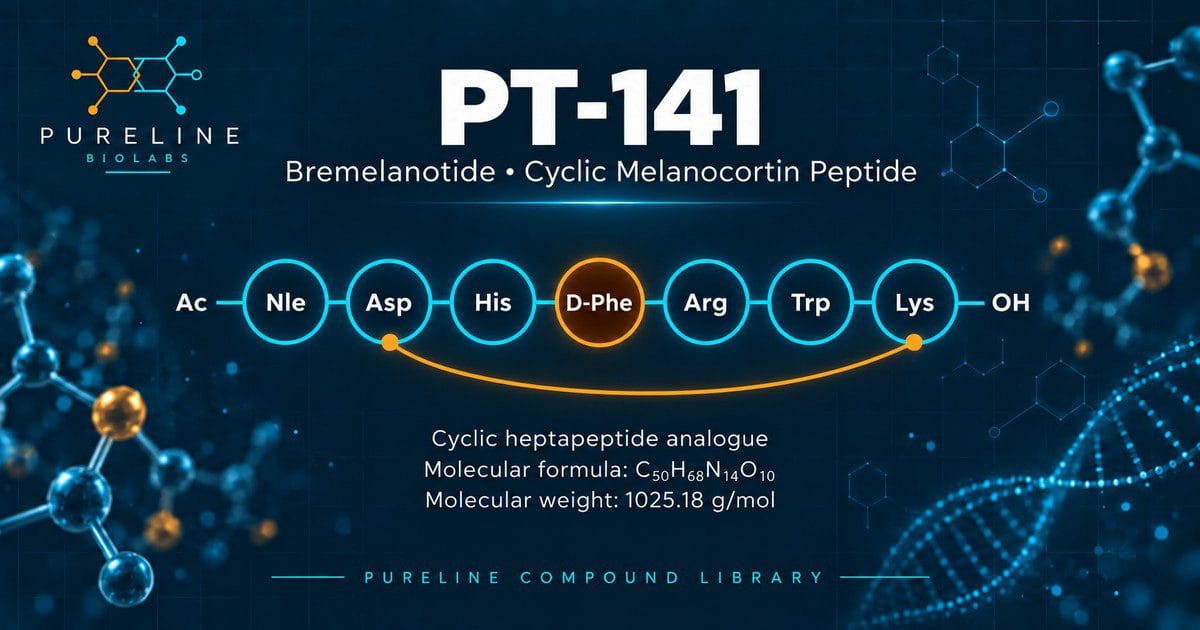
PT-141, also known as bremelanotide, is a synthetic cyclic heptapeptide related to alpha-melanocyte-stimulating hormone. Its seven residues include two non-standard building blocks, norleucine and D-phenylalanine, and a lactam ring joins the aspartic acid and lysine side chains.
PT-141 carries a larger human evidence base than most research peptides. A sterile bremelanotide acetate injection was approved by the US Food and Drug Administration in 2019 under the brand name Vyleesi, for one narrowly defined indication in premenopausal women. That approval covers a specific pharmaceutical product, formulation, dose, route and manufacturing standard.
Pureline Biolabs supplies PT-141 as a lyophilised laboratory research material. It is not Vyleesi, it is not supplied as a medicine, and the US approval does not extend to it. Pureline publishes independent batch-specific analytical results for the stock it holds. The published bremelanotide literature does not certify the identity, purity or quantity of any individual retail vial.
Chemical Identity
| Field | Information |
|---|---|
| Standard name | Bremelanotide |
| Development code | PT-141 |
| Peptide class | Synthetic cyclic heptapeptide |
| Amino-acid sequence | Ac-Nle-c[Asp-His-D-Phe-Arg-Trp-Lys]-OH |
| Amino-acid count | Seven residues |
| Cyclisation | Lactam ring between the Asp and Lys side chains |
| Non-standard residues | Norleucine (Nle) and D-phenylalanine (D-Phe) |
| Terminal groups | Acetylated N-terminus, free carboxylic acid C-terminus |
| Free-peptide molecular formula | C50H68N14O10 |
| Free-peptide molecular weight | 1025.18 g/mol |
| CAS number | 189691-06-3 |
| PubChem CID | 9941379 |
| Related compound | Melanotan II |
| Research categories | Melanocortin receptor pharmacology, neuroendocrine signalling, sexual-function research |
| Form supplied | Lyophilised powder in a sealed research vial |
| Pureline storage condition | Refrigerated at 2-8°C, protected from light and moisture |
| Pureline classification | Laboratory research material only. Not a medicine, cosmetic or supplement in the UK. |
For general laboratory handling principles, see the Pureline Biolabs peptide reconstitution guide and reconstitution calculator.
PubChem lists bremelanotide under CID 9941379 with the free-peptide formula C50H68N14O10 and a molecular weight of 1025.2 g/mol.[1] The more precise average mass of 1025.18 g/mol is the figure usually quoted on supplier documentation. Salt forms, counterions and water content change the formula weight reported for a supplied preparation, so the material description on an analytical report should be compared rather than relying only on a general database entry.
What PT-141 Is
PT-141 is the development name for bremelanotide. It belongs to a group of synthetic peptides derived from alpha-melanocyte-stimulating hormone, usually abbreviated to alpha-MSH.
Unlike a simple linear peptide, PT-141 contains a ring. Its aspartic acid and lysine side chains are joined by a lactam bond, creating the cyclic section shown in the sequence:
Sequence
Ac-Nle-c[Asp-His-D-Phe-Arg-Trp-Lys]-OH
The prefix Ac indicates an acetylated N-terminus. Nle is norleucine, a non-standard amino acid. D-Phe identifies the D-isomer of phenylalanine. The final OH represents the free carboxylic acid at the C-terminus.
These structural details are not decoration. Omitting the D-configuration, the acetyl group, the cyclisation or the terminal form would describe a chemically different peptide with a different analytical signature.
Relationship Between PT-141 and Melanotan II
PT-141 developed out of research involving Melanotan II. The two compounds share the same cyclic core sequence but differ at the C-terminus.
Melanotan II normally carries an amidated C-terminus, written as NH2. Bremelanotide carries a free carboxylic acid, written as OH.
That apparently small alteration produces a separate compound with its own identity, analytical profile, regulatory history and research literature. Data for Melanotan II should not be presented as evidence for PT-141.
Free Peptide and Acetate Salt
Chemical databases list bremelanotide using the free-peptide formula. Pharmaceutical and research preparations frequently contain bremelanotide acetate instead, and the counterion changes the mass of the supplied material.
The scale of that difference is visible in the approved product. Each Vyleesi autoinjector contains 1.75 mg of bremelanotide, described on the label as equivalent to 1.89 mg of bremelanotide acetate in 0.3 mL of solution.[2] Water content and other counterions can create further differences between calculated and measured mass.
Pureline states the exact salt form only where batch documentation confirms it. A general database formula is not a substitute for the specification of the material inside a particular vial.
Evidence by Research Level
PT-141 has a broader evidence base than most research peptides, but every result still belongs to a defined compound, formulation, route and experimental setting.
Receptor Pharmacology
Bremelanotide is a melanocortin receptor agonist. The FDA prescribing information for the approved product describes it as nonselectively activating several receptor subtypes, in the order of potency MC1R, MC4R, MC3R, MC5R, MC2R, and states that binding to MC1R and MC4R is the most relevant at therapeutic doses.[2]
Earlier work describes PT-141 as an agonist at melanocortin receptors including MC3R and MC4R, which are expressed primarily in the central nervous system.[7] The two descriptions are consistent: the compound is not subtype-selective, and which subtype dominates depends on the concentration, tissue and assay. A claim that PT-141 acts on one receptor only is not supported.
Animal Research
Animal work preceded human development. Administration of PT-141 to rats and non-human primates was reported to produce penile erections, and systemic administration to rats increased c-Fos immunoreactivity in hypothalamic neurons. Neurons in that same region took up pseudorabies virus injected into the corpus cavernosum, which is how the work linked the central signal to the peripheral tissue.[7]
These are controlled animal experiments describing a receptor pathway. They do not establish human efficacy, a safe exposure level or a suitable route.
Early Human Research
A double-blind, placebo-controlled Phase 1 study examined intranasal PT-141 in healthy men and in men with mild-to-moderate erectile dysfunction who responded to sildenafil. Erectile response measured by RigiScan was statistically significant against placebo at doses above 7 mg, with the first erection occurring after roughly 30 minutes. Flushing and nausea were the most common adverse events and no maximum tolerated dose was identified.[5]
A separate randomised crossover study gave 19 men with erectile dysfunction 25 mg of sildenafil together with 7.5 mg of intranasal PT-141, and reported a greater erectile response than sildenafil alone.[6]
Both studies used a particular intranasal formulation at defined doses in a clinical setting. Neither supports a claim about lyophilised research powder, a different route or self-directed use. PT-141 was never approved in the United States as a treatment for male erectile dysfunction.
Phase 3 Human Research
Two identical randomised, double-blind, placebo-controlled Phase 3 trials, known together as RECONNECT, examined bremelanotide 1.75 mg given subcutaneously as needed in premenopausal women with hypoactive sexual desire disorder. Of 1,267 women randomised, 1,247 were in the safety population and 1,202 in the modified intent-to-treat population, across 24 weeks of treatment.[3]
Both co-primary endpoints reached statistical significance. The size of the change is worth stating alongside that: the integrated increase in the Female Sexual Function Index desire domain was 0.35 against placebo, and the integrated reduction in desire-related distress was 0.33. Nausea, flushing and headache each occurred in 10 per cent or more of treated participants in both studies.[3]
A 52-week open-label extension followed. Of the 856 patients eligible after the core phase, 684 enrolled and 272 completed it. Nausea was reported by 40.4 per cent, flushing by 20.6 per cent and headache by 12.0 per cent, and no new safety signals were identified.[4] Open-label evidence carries different limitations from the blinded phase, because participants and investigators both know what is being given, and a completion rate of 272 out of 684 is itself part of the picture.
These findings relate to a defined pharmaceutical formulation given at a fixed dose to a selected participant population. They do not verify, approve or describe Pureline's research material.
US Regulatory Status
The FDA approved Vyleesi in 2019 for the treatment of premenopausal women with acquired, generalised hypoactive sexual desire disorder, where the low desire causes marked distress and is not due to a co-existing medical or psychiatric condition, relationship problems, or the effects of another medication.[2]
The authorised product is a sterile solution of 1.75 mg bremelanotide in 0.3 mL, supplied in a single-dose subcutaneous autoinjector, and its approval covers pharmaceutical manufacturing, sterility, formulation, packaging, instructions, contraindications and post-market controls.[2]
Pureline's PT-141 is a lyophilised laboratory research material. Approval of Vyleesi does not transfer to it, to any research vial, or to any preparation made from one.
What Is Not Established
Published research has not established
- That Pureline PT-141 is equivalent to Vyleesi
- An approved UK therapeutic use for Pureline's research material
- Suitability for human or veterinary use
- Sterility or endotoxin status, neither of which was tested for this batch
- That research-grade powder meets pharmaceutical manufacturing requirements
- Approval for male erectile dysfunction in any jurisdiction
- Equivalence between PT-141 and Melanotan II
- Safety of unlicensed formulations or routes
- The performance of Pureline batch PLB-012 on the basis of general scientific literature
Pureline Biolabs does not present PT-141 as a treatment for sexual dysfunction, hormonal conditions or any other medical condition.
Research limitations worth knowing
- The pharmaceutical studies used defined bremelanotide acetate formulations, not research powder
- The early trials used an intranasal product; the Phase 3 trials used a subcutaneous injection
- Trial results apply to the selected participant populations enrolled
- Study endpoints relied partly on participant-reported measures
- The open-label extension carries a greater risk of expectation bias, and most enrolled participants did not complete it
- Melanotan II findings cannot be transferred to PT-141
- Free bremelanotide and bremelanotide acetate have different formula weights
- Chromatographic area purity does not establish sterility, endotoxin status or clinical performance
- A published trial cannot certify the contents of a commercial research vial
- Regulatory approval of one product in one country does not approve a different product sold elsewhere
Current Pureline Batch
The values above are taken from the Janoshik report for the sample submitted from batch PLB-012. The certificate reports a measured amount and a purity percentage. It does not name the analytical method, and it does not report a separate identity, sequence-confirmation, sterility or endotoxin result, so none of those should be inferred from it. The measured amount of 9.65mg is below the 10mg labelled vial size. This panel is updated when Pureline changes to a new batch, and earlier reports are kept under their original batch codes rather than replaced.
What the Test Results Show
| Method | What it shows | What it does not show by itself |
|---|---|---|
| Chromatographic purity | The relative peak area assigned to the target compound under the stated test method | Exact vial amount, identity, sterility or endotoxin level |
| Quantity analysis | The amount of target material measured in the submitted sample | Purity, sterility, safety or clinical effect |
| Mass spectrometry | Whether detected mass data are consistent with the expected molecule | Complete sequence proof, exact quantity, sterility or biological activity |
| Endotoxin test | Bacterial endotoxin level under the named method | Chemical identity or general sterility |
| Sterility test | Microbial growth under defined test conditions | Chemical purity, identity or suitability for administration |
The certificate for batch PLB-012 covers the first two rows of that table only. Mass spectrometry, endotoxin testing and sterility testing were not commissioned for this batch, and this page makes no claim about them.
A 99.874 per cent purity result answers one narrow analytical question. It does not mean the vial is 99.874 per cent correctly filled, sterile or safe. It is also worth noting that a cyclic peptide containing a D-amino acid and a non-standard residue cannot be distinguished from a linear or all-L variant by a purity percentage alone. That would require a method the certificate does not report.
PT-141 Compared With Related Research Peptides
| Compound | Sequence and size | Relationship to PT-141 |
|---|---|---|
| Melanotan II | Cyclic heptapeptide, same core sequence, amidated C-terminus | Closest relative. The C-terminal difference makes it a separate compound with its own literature and analytical profile. |
| Melanotan I | Linear 13-residue alpha-MSH analogue, also called afamelanotide | Different structure and receptor emphasis. Studied mainly in MC1R and pigmentation research rather than central signalling. |
| alpha-MSH | Linear 13-residue endogenous peptide | The parent sequence family. PT-141 is a synthetic analogue, not a fragment of it, and findings do not transfer between them. |
| KPV | Lys-Pro-Val, the C-terminal three residues of alpha-MSH | Shares the melanocortin lineage only. Studied in inflammatory and epithelial models, not sexual-function research. |
Common Questions
Is PT-141 the same as bremelanotide?
PT-141 is the development code for bremelanotide. They name the same peptide, but a supplier should still state the exact salt form and terminal structure of the material, because those affect how the compound appears in analytical records.
What is the PT-141 peptide sequence?
The sequence is Ac-Nle-c[Asp-His-D-Phe-Arg-Trp-Lys]-OH. The aspartic acid and lysine side chains form a lactam ring, which is what makes the peptide cyclic.
How many amino acids does PT-141 contain?
Seven residues, including norleucine and D-phenylalanine, neither of which is one of the twenty standard amino acids.
What is the molecular formula of PT-141?
The free-peptide formula is C50H68N14O10, with a molecular weight of approximately 1025.18 g/mol. Bremelanotide acetate has a different formula weight, which is why the salt form should be stated rather than assumed.
Is PT-141 the same as Melanotan II?
No. They share a closely related cyclic sequence, but their C-terminal structures differ. PT-141 has a free carboxylic acid; Melanotan II normally has a C-terminal amide. They are separate compounds with separate research records.
Which melanocortin receptors does PT-141 act on?
It is not subtype-selective. The FDA prescribing information for the approved product gives an order of potency of MC1R, MC4R, MC3R, MC5R, MC2R, and identifies MC1R and MC4R binding as the most relevant at therapeutic doses. Earlier research emphasised MC3R and MC4R, which are expressed mainly in the central nervous system.
Has PT-141 been studied in humans?
Yes. Early intranasal studies and two Phase 3 subcutaneous trials were conducted using defined pharmaceutical formulations. Those studies do not establish that research-grade PT-141 from any other source has the same purity, formulation, safety or performance.
Is PT-141 approved by the FDA?
The FDA approved the Vyleesi pharmaceutical product in 2019 for one narrow indication in premenopausal women. That approval does not cover research-grade PT-141 supplied by Pureline or by any other laboratory supplier, and it has never covered male erectile dysfunction.
Does the Pureline purity result prove pharmaceutical quality?
No. It reports the chromatographic purity of the submitted batch sample. Pharmaceutical quality requires validated manufacturing, sterility, endotoxin assessment, stability data and regulated product release, none of which a purity percentage addresses.
How can I verify Pureline Biolabs PT-141?
Match batch code PLB-012 on the vial with the entry in Pureline's batch records. You can then open the independent Janoshik record and compare the task number, testing dates, reported amount and purity result against what is published here.
References
- National Center for Biotechnology Information. Bremelanotide. PubChem CID 9941379. PubChem
- US Food and Drug Administration. Vyleesi (bremelanotide injection) prescribing information. 2019. FDA label
- Kingsberg SA, Clayton AH, Portman D, et al. Bremelanotide for the treatment of hypoactive sexual desire disorder: two randomized phase 3 trials. Obstet Gynecol. 2019;134(5):899-908. PubMed 31599840
- Simon JA, Kingsberg SA, Portman D, et al. Long-term safety and efficacy of bremelanotide for hypoactive sexual desire disorder. Obstet Gynecol. 2019;134(5):909-917. PubMed 31599847
- Diamond LE, Earle DC, Rosen RC, Willett MS, Molinoff PB. Double-blind, placebo-controlled evaluation of the safety, pharmacokinetic properties and pharmacodynamic effects of intranasal PT-141, a melanocortin receptor agonist, in healthy males and patients with mild-to-moderate erectile dysfunction. Int J Impot Res. 2004;16(1):51-59. PubMed 14963471
- Diamond LE, Earle DC, Garcia WD, Spana C. Co-administration of low doses of intranasal PT-141, a melanocortin receptor agonist, and sildenafil to men with erectile dysfunction results in an enhanced erectile response. Urology. 2005;65(4):755-759. PubMed 15833522
- Molinoff PB, Shadiack AM, Earle D, Diamond LE, Quon CY. PT-141: a melanocortin agonist for the treatment of sexual dysfunction. Ann N Y Acad Sci. 2003;994:96-102. PubMed 12851303
All products sold by Pureline Biolabs Ltd are intended strictly for laboratory research purposes only. Not approved for human consumption, veterinary use, or any other application. Not evaluated by the MHRA or any other regulatory authority. Pureline Biolabs Ltd · Company No. 17236739 · purelinebiolabs.com