


Semax: Structure, Research Evidence and Batch Testing
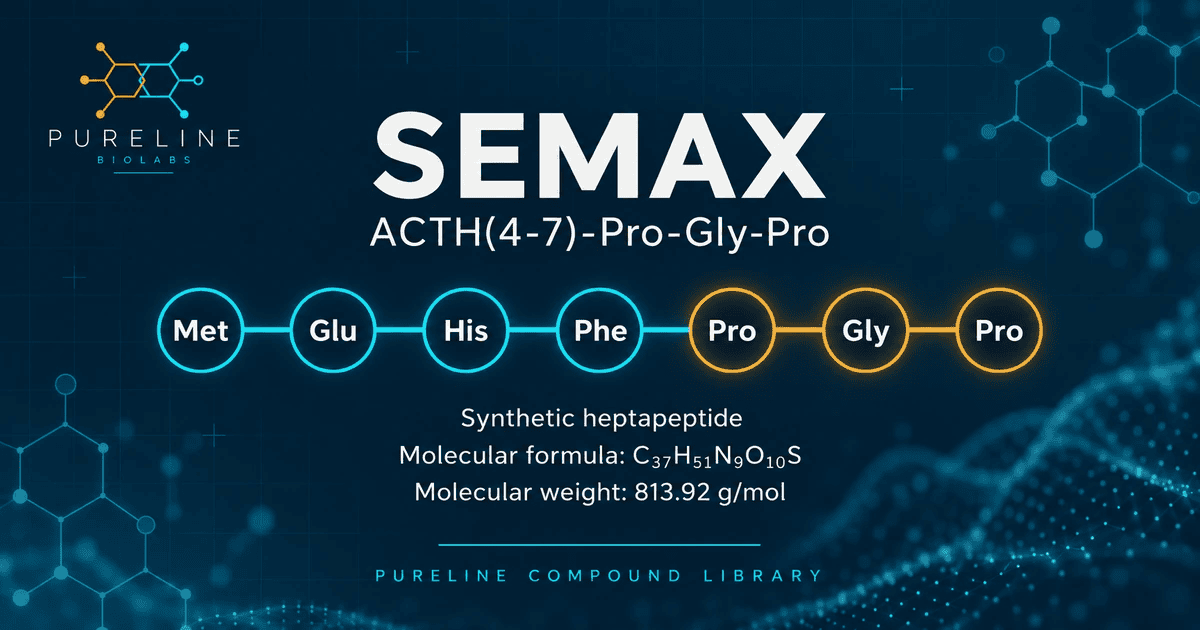
Semax is a synthetic heptapeptide with the sequence Met-Glu-His-Phe-Pro-Gly-Pro, commonly described as ACTH(4-7)-Pro-Gly-Pro. Experimental research has examined its effects on neurotrophin-related gene expression, including BDNF and its receptor TrkB, principally in cellular and rodent models. Evidence from these models cannot be assumed to establish an equivalent effect in humans.
Pureline Biolabs publishes independent, batch-specific HPLC and LC-MS results for the Semax stock it supplies. These analytical results describe the tested batch and should not be confused with evidence of biological activity, safety or clinical efficacy.
Chemical Identity
| Field | Information |
|---|---|
| Standard name | Semax |
| Sequence | Met-Glu-His-Phe-Pro-Gly-Pro |
| Structural description | ACTH(4-7) fragment (Met-Glu-His-Phe) with a Pro-Gly-Pro tail added at the C-terminus |
| Molecular formula | C₃₇H₅₁N₉O₁₀S |
| Molecular weight | 813.92 g/mol |
| CAS number | 80714-61-0 |
| Variants | Semax free peptide is distinct from Semax acetate and other modified variants; specifications differ by form |
| Origin | Developed at the Institute of Molecular Genetics, Russian Academy of Sciences |
| Pureline classification | Supplied solely as a laboratory research material. Not intended for human, veterinary, cosmetic or dietary use. |
For general laboratory handling principles, see the Pureline Biolabs peptide reconstitution guide and reconstitution calculator.
The sequence and molecular formula are confirmed by PubChem [1]. The Pro-Gly-Pro tail distinguishes Semax from the natural ACTH(4-7) fragment and forms part of the compound's designed structure. Although literature commonly associates this addition with improved resistance to enzymatic breakdown, Semax should not be described as generally stable. A rat intranasal study reported rapid enzymatic degradation, with Pro-Gly-Pro becoming a prominent detected fragment [6].
Cell-Culture Research
Early work exposing rat glial cell cultures to Semax reported rapid induction of both NGF and BDNF mRNA [2]. This is an isolated cell-culture finding — a measured change in gene transcript levels within cultured cells, not a demonstrated cognitive, mental or clinical effect. Findings at this level should not be translated into claims about behaviour or outcomes.
Animal Research
Semax has been investigated for changes in BDNF-related expression in experimental models, principally in rats. Intranasal administration in rat models has been reported to increase BDNF protein levels and TrkB phosphorylation in the hippocampus and basal forebrain [3,4]. Separate gene-expression studies in rat brain tissue, including under focal cerebral ischemia models, have reported broader changes in neurotrophin and other gene expression following Semax administration [5].
These are preclinical, animal-model results using intranasal administration in rats at defined doses. Species, administration route, dose and brain region all affected the reported outcomes, and findings from one study should not be generalised to others.
Reported Clinical Use and UK Status
Semax has a documented history of clinical use in Russia, where it has been used in a nasal-spray form. That regulatory and clinical history is specific to Russia and is separate from Semax's status in the UK, where it holds no marketing authorisation and is not evaluated by the MHRA. Regional clinical use elsewhere does not constitute evidence for, or approval of, Pureline's research-grade material.
Not Established
What The Evidence Does Not Show
- No published trial has evaluated Pureline's specific Semax batch
- No established benefit has been demonstrated in healthy human volunteers
- Animal and cell-culture results do not establish an equivalent effect in humans
- No UK marketing authorisation has been identified for Semax
- Findings should not be used to infer safety, dosing, or treatment effect for any application
The Pureline Testing Standard
Every Semax batch we stock passes through Janoshik Analytical before it's listed for sale. We publish the resulting Certificate of Analysis against the specific batch number printed on your vial, so the number on the report and the number on the shelf are always the same lot.
Current Pureline Batch
Reported amount and purity figures are taken directly from the laboratory's own report for this batch. This panel reflects the batch currently listed for sale and is updated when stock changes.
Testing Methods Explained
| Method | What it actually shows |
|---|---|
| HPLC | Reports chromatographic purity based on relative peak area under the stated test conditions. Does not determine absolute vial quantity by itself. |
| LC-MS | Supports the assigned molecular identity through mass and retention-time evidence. Sequence confirmation specifically would require dedicated MS/MS analysis. |
Common Questions
Why does Semax include the Pro-Gly-Pro sequence if it's not part of natural ACTH?
The Pro-Gly-Pro tripeptide is a stability-enhancing addition, not a natural part of the ACTH hormone. Short peptide fragments are typically broken down by enzymes quickly once in solution; this addition is reported to slow that breakdown, which relates to why Semax is used as a distinct research article rather than the unmodified ACTH fragment.
Does Semax have any regulatory status in the UK?
No. Whatever clinical use Semax has in Russia has no bearing on its status in the UK — here it is sold strictly as a research chemical for laboratory use, not as a medicine, supplement, or any consumer product, and it has no UK marketing authorisation.
How does Semax differ from Selank as a research compound?
Semax and Selank are structurally unrelated peptides that are both studied in cognitive and neurological research contexts. Semax derives from an ACTH fragment and is investigated principally for BDNF/TrkB-related gene expression; Selank is a synthetic tuftsin analogue studied mainly for anxiolytic and immune-modulatory effects. Their precise receptor mechanisms are not fully established, so they should be treated as distinct research subjects rather than substitutes for one another.
What does the Certificate of Analysis actually verify?
A COA from Janoshik Analytical reports two separate things for the tested sample: LC-MS evidence supporting the assigned molecular identity, and HPLC-reported chromatographic purity as a percentage based on relative peak area. Together they describe what was detected in the sample and its purity under the stated method — not a guarantee of biological activity or effect.
References
- ACTH (4-7), Pro-Gly-Pro- (Semax). PubChem CID 9811102. PubChem
- Shadrina MI, Dolotov OV, Grivennikov IA, et al. Rapid induction of neurotrophin mRNAs in rat glial cell cultures by Semax, an adrenocorticotropic hormone analogue. Neurosci Lett. 2001;308(2):115-118. PubMed 11457573
- Dolotov OV, Karpenko EA, Inozemtseva LS, et al. Semax, an analog of ACTH(4-10) with cognitive effects, regulates BDNF and trkB expression in the rat hippocampus. Brain Res. 2006;1117(1):54-60. ScienceDirect
- Dolotov OV, Seredenina TS, Levitskaya NG, et al. Semax, an analogue of adrenocorticotropin(4-10), binds specifically and increases levels of brain-derived neurotrophic factor protein in rat basal forebrain. J Neurochem. 2006. Wiley
- Medvedeva EV, Dmitrieva VG, Povarova OV, et al. The peptide Semax affects the expression of genes related to the immune and vascular systems in rat brain focal ischemia: genome-wide transcriptional analysis. BMC Genomics. 2014;15:228. DOI: 10.1186/1471-2164-15-228
- Shevchenko KV, Nagaev IYu, Alfeeva LYu, et al. Kinetics of Semax penetration into the brain and blood of rats after its intranasal administration. Russ J Bioorg Chem. 2006;32(1):57-62. DOI: 10.1134/S1068162006010055
All products sold by Pureline Biolabs Ltd are intended strictly for laboratory research purposes only. Not approved for human consumption, veterinary use, or any other application. Not evaluated by the MHRA or any other regulatory authority. Pureline Biolabs Ltd · Company No. 17236739 · purelinebiolabs.com