

Selank Peptide: Sequence, Research Evidence and Batch Testing
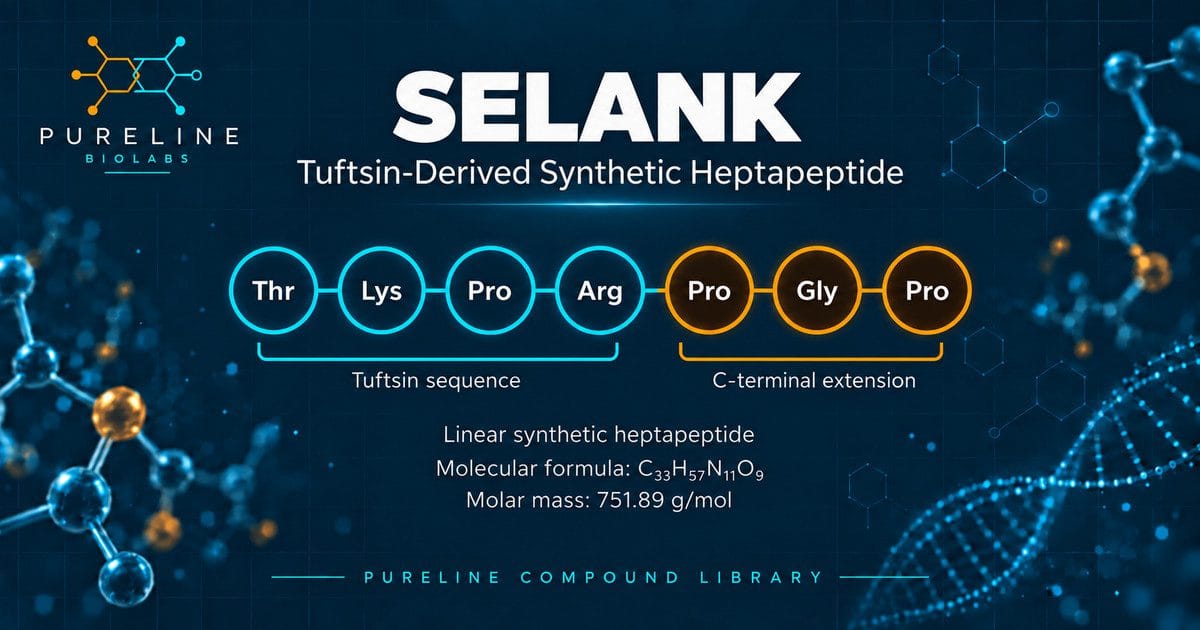
Selank is a synthetic linear heptapeptide with the sequence Thr-Lys-Pro-Arg-Pro-Gly-Pro, abbreviated TKPRPGP. It was designed from tuftsin, a naturally occurring tetrapeptide with the sequence Thr-Lys-Pro-Arg. Selank retains that four-residue sequence and adds Pro-Gly-Pro at the C-terminus.
Laboratory studies have examined Selank in relation to gene expression, GABA-associated signalling, brain-derived neurotrophic factor and behavioural models. Two published randomised human studies have reported findings in anxiety-related populations, both against benzodiazepine comparators. Much of this work comes from a limited group of Russian research centres, and large, independently replicated clinical trials are lacking. Those results cannot be treated as proof that a separately manufactured research vial is effective, safe or suitable for administration.
Pureline Biolabs supplies Selank as a laboratory research material only. Pureline separates two different types of evidence. Published papers describe Selank generally under the conditions used by their authors. Pureline's batch-specific laboratory report addresses the sample submitted from the stock Pureline holds.
Chemical Identity
| Field | Information |
|---|---|
| Standard name | Selank |
| Sequence | Thr-Lys-Pro-Arg-Pro-Gly-Pro |
| One-letter sequence | TKPRPGP |
| Peptide length | Seven amino-acid residues |
| Peptide class | Linear synthetic heptapeptide |
| Structural relationship | Tuftsin analogue with a C-terminal Pro-Gly-Pro extension |
| Molecular formula | C33H57N11O9 |
| Molar mass | 751.89 g/mol |
| CAS number | 129954-34-3 |
| PubChem CID | 11765600 |
| Common research name | TP-7 |
| Research categories | Peptide signalling, neurochemical research, gene-expression studies, behavioural models |
| Form supplied by Pureline | Lyophilised laboratory research material |
| Pureline classification | For laboratory research only. Not for human consumption or veterinary use. |
For general laboratory handling principles, see the Pureline Biolabs peptide reconstitution guide and reconstitution calculator.
The formula and molar mass above describe the neutral peptide entry recorded by PubChem.[1] Material supplied with acetate, water or another associated component may have a different total composition. The exact form tested should be stated in the batch documentation.
How Selank Relates to Tuftsin
Tuftsin is the naturally occurring tetrapeptide Thr-Lys-Pro-Arg. Selank contains the complete tuftsin sequence followed by Pro-Gly-Pro.
| Peptide | Sequence | Residues |
|---|---|---|
| Tuftsin | Thr-Lys-Pro-Arg | Four |
| Selank | Thr-Lys-Pro-Arg-Pro-Gly-Pro | Seven |
This relationship is why Selank is usually described as a synthetic tuftsin analogue rather than an endogenous human peptide. The added C-terminal sequence changes the molecule's length, formula and research behaviour. Findings about tuftsin should not automatically be attributed to Selank, and findings about Selank should not be treated as findings about tuftsin.
Evidence by Research Level
Selank research spans biochemical assays, cultured cells, animal experiments and small human studies. These evidence levels answer different questions and should not be combined into a single claim.
Chemical and Molecular Characterisation
Selank has a defined seven-residue sequence and molecular mass. Analytical databases record the neutral peptide as C33H57N11O9 with an average molecular mass of approximately 751.9 g/mol.[1] These values provide a reference for identity testing, but matching an expected mass alone does not prove full sequence order, purity, quantity or sterility.
The peptide contains three proline residues. Its proline-rich structure and relationship to tuftsin have made it a subject of peptide-signalling and degradation research.[4] Chemical identity is the starting point for studying Selank, not evidence of a particular biological result.
In-Vitro Research
A 2017 study examined human neuroblastoma IMR-32 cells. It reported no change in the mRNA levels of the GABAergic-system genes studied under Selank alone. When Selank was applied together with GABA, the combination largely suppressed the expression changes that GABA produced on its own: of fourteen genes altered by GABA, only one remained significantly changed once Selank was added.[3]
That result is a direct caution against reducing Selank to a claim that it simply raises GABA activity. In this model Selank did not act as a GABA agonist. It damped a GABA-driven transcriptional response, and it did nothing measurable on its own. The observed effect depended entirely on the model and experimental context, and it does not establish a clinical mechanism in humans.
Animal Research
A 2016 study administered Selank or GABA intranasally to thirty male Wistar rats and compared the resulting changes in the expression of genes involved in GABAergic neurotransmission. A positive correlation was reported between the two sets of expression changes one hour after administration (r = 0.86, p ≤ 0.05), although some genes responded to only one of the two compounds.[2]
A separate rat study reported that intranasal Selank regulated brain-derived neurotrophic factor expression in the hippocampus, measured at both protein and mRNA level.[5] Other animal work has examined behaviour, memory-related tasks, stress models and changes in gene expression within brain regions.[6]
Animal findings can help form research questions, but they cannot establish a human outcome. Species differences, experimental stressors, route, timing and measured endpoints all affect the result.
Human Research
A 2008 randomised comparative study enrolled 62 participants with generalised anxiety disorder or neurasthenia. Thirty received Selank and thirty-two received medazepam, a benzodiazepine. The authors reported broadly similar anxiolytic effects between the two, with additional antiasthenic and psychostimulant effects attributed to Selank, alongside serum enkephalin measurements.[7]
A 2014 study compared Selank with phenazepam, also a benzodiazepine, in 60 patients with phobic-anxiety and somatoform disorders (ICD-10 F40.2-9, F41.1-9, F45.0-1). It reported anxiolytic and mild nootropic effects, with the anxiolytic effect persisting for a week after treatment ended.[8]
These are the two publications most frequently cited in commercial Selank summaries, and their limits matter. Both are small. Both come from the same research community. Much of the underlying literature is available only in Russian or as brief translated abstracts, reporting does not always meet current international trial standards, and independent replication outside that community is sparse. A 2021 pharmacotherapy review classed Selank among poorly studied products.[9] These studies should not be presented as proof that Selank is an established treatment.
Evidence Summary
| Research level | What has been studied | Main limit |
|---|---|---|
| Chemical identity | Sequence, formula and molecular mass | Does not establish biological activity or product quality |
| Cell and molecular work | GABAergic gene expression in IMR-32 cells | Model-dependent findings do not establish a human mechanism |
| Animal work | Gene expression, BDNF, behaviour, stress and memory-related models in rats | Animal results cannot predict a safe or effective human outcome |
| Human publications | Two randomised comparisons against benzodiazepines, 62 and 60 patients | Limited size, reporting, geographical spread and independent replication |
| Pureline batch analysis | Reported purity and quantity of the submitted stock sample | Does not establish safety, effectiveness, sterility or whole-batch uniformity |
What Is Not Established
No published study has tested Pureline Biolabs' current Selank batch for a biological or clinical outcome. General Selank literature cannot certify the identity or performance of a particular retail vial.
The available evidence does not establish
- That Selank is an approved treatment for anxiety in the United Kingdom
- That findings from cultured cells or rodents will occur in humans
- That two small published human studies prove broad effectiveness or long-term safety
- That Pureline's research material is equivalent to any pharmaceutical preparation studied elsewhere
- That HPLC purity proves identity, exact vial quantity, sterility or endotoxin status
- That one submitted sample certifies every vial or a later batch
- That a laboratory report makes a product suitable for human or animal administration
Limitations worth knowing
- Selank research is concentrated among a relatively small number of research groups
- Several often-cited human publications have limited methodological detail available in English
- Large, independently replicated and internationally registered clinical trials are lacking
- A 2021 review of sedative-hypnotic agents classed Selank among poorly studied products[9]
- GABA modulation is a research hypothesis, not a complete or settled human mechanism, and the clearest cell study found Selank suppressed rather than reproduced a GABA response
- Gene-expression changes show that measured RNA levels differed under specified conditions, not that a clinical outcome occurred
- BDNF findings reported in rat brain tissue cannot be translated directly into a human cognitive or anxiety claim
- Selank and tuftsin are related but chemically distinct peptides
- Selank and Semax are different sequences derived from different parent peptides
- HPLC peak-area purity does not measure exact vial quantity
- Routine intact-mass testing supports identity but does not prove every structural feature
- Storage stability depends on material form, moisture, temperature, light and time
What Pureline Biolabs Independently Adds
First-party evidence
Most Selank pages repeat the same general research summaries. Pureline adds batch information that the literature cannot provide: the batch code shown on the vial, the identity of the independent analytical laboratory, the laboratory task number and direct verification key, the reported results, and links connecting the product, the report and the current batch record, alongside a cold-chain record covering storage and handling while the stock remained under Pureline's control.
This lets a reader distinguish the known chemical identity of Selank from the measured characteristics of Pureline's submitted batch sample.
Current Pureline Batch
The values above are taken from the Janoshik report for the sample submitted from batch PLB-006. The reported amount of 10.43mg is marginally above the 10mg labelled vial size, which is consistent with normal fill tolerance. This certificate reports quantity and chromatographic purity; it does not report a separate sterility, endotoxin or stereochemical result, and none should be inferred from it. The panel is updated when Pureline changes to a new batch, and earlier reports are kept with their original batch codes rather than replaced.
The Pureline Testing Standard
What a Selank batch record should contain
- HPLC to report relative chromatographic peak-area purity
- Mass spectrometry to test whether detected mass data are consistent with Selank
- Quantity analysis when the vial amount is presented as independently measured
- A visible batch code linking the vial to the report
- The laboratory task number and direct verification link
- Separate sterility, endotoxin or heavy-metal results only when those tests were commissioned for that batch
Testing Methods Explained
| Method | What it shows | What it does not show by itself |
|---|---|---|
| HPLC | Relative chromatographic peak-area purity under the stated method | Full identity, exact vial amount, sterility or endotoxin level |
| LC-MS | Whether detected mass data are consistent with the expected Selank molecule | Complete sequence proof, exact quantity, sterility or biological activity |
| Quantity analysis | Amount of target material measured in the submitted sample | Purity, sterility, safety or clinical effect |
| Peptide mapping or fragmentation | Additional sequence information, depending on method and coverage | Automatic proof of every structural or stereochemical feature |
| Endotoxin test | Bacterial endotoxin level under the named test method | Chemical identity or general sterility |
| Sterility test | Microbial growth under defined test conditions | Chemical purity, identity or suitability for administration |
A 99 per cent HPLC result means that approximately 99 per cent of the detected chromatographic peak area was assigned to the target peak under that method. It does not mean that the vial is 99 per cent correctly filled, 99 per cent sterile or 99 per cent safe.
Storage and Traceability
Pureline stores Selank according to the conditions printed on its label and batch documentation. The cold-chain log records storage and handling while the material remains under Pureline's control. It does not replace analytical testing and should not be described as proof that no degradation occurred.
Stability depends on the peptide form, residual moisture, container closure, temperature, light exposure and time. A general storage statement cannot supply a validated shelf life for every formulation.
Common Questions
What is Selank peptide?
Selank is a synthetic linear heptapeptide with the sequence Thr-Lys-Pro-Arg-Pro-Gly-Pro. It is usually described as a tuftsin analogue because its first four residues match the tuftsin sequence.
What is the Selank peptide sequence?
The full sequence is Thr-Lys-Pro-Arg-Pro-Gly-Pro. Its one-letter amino-acid code is TKPRPGP.
What are the Selank molecular formula and molecular weight?
PubChem records Selank as C33H57N11O9 with a molecular weight of approximately 751.9 g/mol. Salt and hydrate forms may have a different total composition.
Is Selank a naturally occurring peptide?
No. Selank is synthetic. It was designed from tuftsin, a naturally occurring tetrapeptide, and adds Pro-Gly-Pro to the tuftsin sequence.
Is Selank the same as tuftsin?
No. Tuftsin contains four residues, Thr-Lys-Pro-Arg. Selank contains seven, Thr-Lys-Pro-Arg-Pro-Gly-Pro. Their relationship does not make them interchangeable.
What is the difference between Selank and Semax?
Selank is the tuftsin-related sequence Thr-Lys-Pro-Arg-Pro-Gly-Pro. Semax is an ACTH-derived heptapeptide with the sequence Met-Glu-His-Phe-Pro-Gly-Pro. They share the final Pro-Gly-Pro segment but have different parent sequences and research histories.
What does research say about Selank and GABA?
The picture is more complicated than the common claim that Selank raises GABA activity. In human IMR-32 cells, Selank alone changed none of the GABAergic genes measured, and when combined with GABA it largely suppressed the changes GABA produced on its own. In rats, intranasal Selank and GABA produced correlated gene-expression changes one hour after administration. These are model-dependent research findings, not a demonstrated clinical mechanism, and they do not show that Selank acts like a benzodiazepine.
Has Selank been studied in humans?
Yes. Two published randomised studies report findings in anxiety-related populations, one comparing Selank with medazepam in 62 participants and one comparing it with phenazepam in 60 patients. The evidence base remains limited by study size, reporting standards and lack of broad independent replication.
Is Selank approved for anxiety treatment in the UK?
No. The studies cited on this page do not establish UK marketing authorisation. Pureline supplies Selank only as a laboratory research material and does not present it as a medicine or treatment.
How is Pureline Biolabs Selank tested?
Pureline submits a sealed sample from each batch to Janoshik Analytical before release. For batch PLB-006 the laboratory reported 98.913 per cent purity and a measured amount of 10.43mg under task number 209940, and the report can be checked directly through the verification link in the batch record above.
What does a Selank Certificate of Analysis prove?
It proves only what the listed analytical methods measured in the submitted sample. Purity and quantity results do not establish clinical safety, effectiveness, sterility, endotoxin level or suitability for administration.
Where can I verify Pureline's Selank batch?
Match the batch code on the vial with the live record on this page, then follow the direct laboratory-verification link. Check the Pureline cold-chain log separately for the storage record covering that stock.
References
- National Center for Biotechnology Information. Selank. PubChem CID 11765600. PubChem
- Volkova A, Shadrina M, Kolomin T, et al. Selank administration affects the expression of some genes involved in GABAergic neurotransmission. Front Pharmacol. 2016;7:31. PubMed 26924987
- Filatova E, Kasian A, Kolomin T, et al. GABA, Selank, and olanzapine affect the expression of genes involved in GABAergic neurotransmission in IMR-32 cells. Front Pharmacol. 2017;8:89. PubMed 28293190
- Vyunova TV, Andreeva LA, Shevchenko KV, Myasoedov NF. The molecular aspects of heptapeptide Selank biological activity. Curr Protein Pept Sci. 2018. PubMed 30255741
- Inozemtseva LS, Karpenko EA, Dolotov OV, et al. Intranasal administration of the peptide Selank regulates BDNF expression in the rat hippocampus in vivo. Dokl Biol Sci. 2008;421:241-243. PubMed 18841804
- Kolik LG, et al. Selank, peptide analogue of tuftsin, protects against ethanol-induced memory impairment by regulating BDNF content in rat brain regions. Bull Exp Biol Med. 2019. PubMed 31625062
- Zozulia AA, Neznamov GG, Siuniakov TS, et al. Efficacy and possible mechanisms of action of a new peptide anxiolytic Selank in the therapy of generalised anxiety disorders and neurasthenia. Zh Nevrol Psikhiatr Im S S Korsakova. 2008;108(4):38-48. PubMed 18454096
- Medvedev VE, Tereshchenko ON, Israelian AIu, et al. A comparison of the anxiolytic effect and tolerability of Selank and phenazepam in the treatment of anxiety disorders. Zh Nevrol Psikhiatr Im S S Korsakova. 2014;114(7):17-22. PubMed 25176261
- Doyno CR, White CM. Sedative-hypnotic agents that affect gamma-aminobutyric acid receptors: focus on phenibut and Selank as poorly studied products. Pharmacotherapy. 2021. PubMed 34396551
All products sold by Pureline Biolabs Ltd are intended strictly for laboratory research purposes only. Not approved for human consumption, veterinary use, or any other application. Not evaluated by the MHRA or any other regulatory authority. Pureline Biolabs Ltd · Company No. 17236739 · purelinebiolabs.com