Copper Peptide Complex — Glycyl-L-Histidyl-L-Lysine — 50mg
Buy GHK-Cu UK from Pureline Biolabs. GHK-Cu is the copper complex of the tripeptide glycyl-L-histidyl-L-lysine, first isolated from human plasma in 1973 by Loren Pickart. It has a long published research history in extracellular-matrix, copper-transport and gene-expression research. Supplied as lyophilised powder for laboratory research. Independently verified at 99.700% purity by Janoshik Analytical, with copper content confirmed at 8.98mg per 50mg vial — see the full batch certificate on our Lab Reports page.
24.99
Inc. VAT · Free UK delivery over £75
Batch PLB-013 · Janoshik Analytical · 99.700% purity confirmed
About GHK-Cu
GHK-Cu (glycyl-L-histidyl-L-lysine copper) is a tripeptide-copper complex first isolated from human plasma in 1973 by Loren Pickart at the University of California San Francisco. GHK-Cu is often compared with AHK-Cu, a related copper tripeptide — read our full GHK-Cu research guide for the differences.
GHK binds copper(II) with high affinity and has been studied as a copper carrier for copper-dependent enzymes such as lysyl oxidase and superoxide dismutase. Gene-expression studies have also profiled broad changes in gene activity in cell models. The limits of this evidence are covered on our GHK-Cu compound profile.
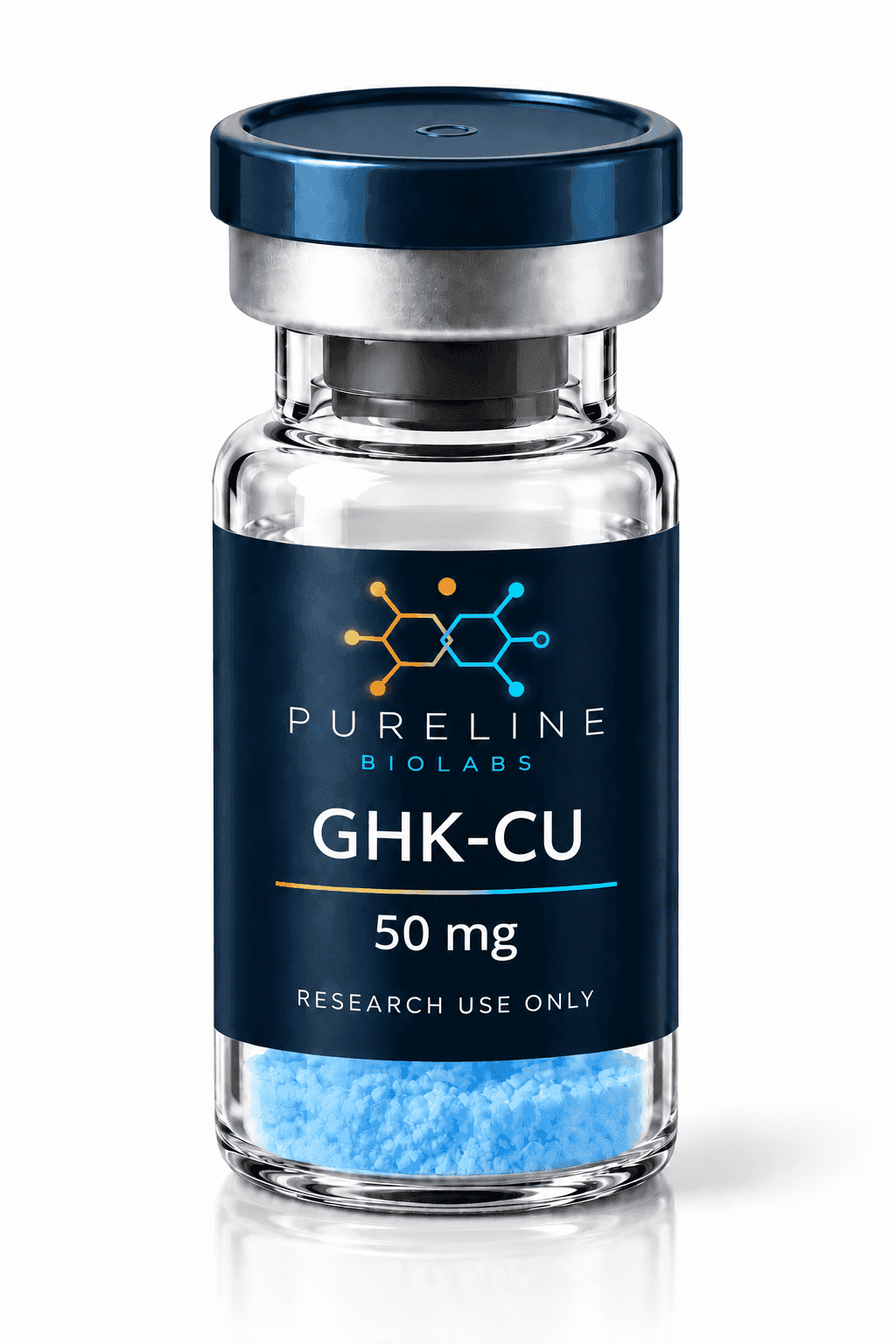
All Pureline Biolabs GHK-Cu is supplied as a lyophilised powder in sealed copper-cap vials, independently tested by Janoshik Analytical at 99.700% purity with copper content confirmed at 8.98mg per 50mg vial.
Product Specifications
| Compound | GHK-Cu |
| Full name | Glycyl-L-Histidyl-L-Lysine Copper |
| Structure | Tripeptide-copper complex |
| Molecular formula | C14H24N6O4 (free GHK tripeptide) |
| Molecular weight | 340.38 g/mol (free GHK tripeptide) · approx. 401.9 g/mol as the 1:1 copper complex |
| CAS number | 89030-95-5 (GHK-Cu copper complex) · 49557-75-7 (free GHK tripeptide) |
| PubChem CID | 73587 (free GHK). PubChem carries several separate records for the copper complex depending on stoichiometry and protonation state, so no single CID is cited for it here. |
| Vial size | 50mg lyophilised powder |
| GHK Content | 43.66mg confirmed |
| Copper Content | 8.98mg confirmed |
| Purity | 99.700% — Janoshik verified |
| Form | Lyophilised powder, sealed vial |
| Manufacturing | Batch-Tested on Receipt |
| Batch | PLB-013 |
| Research use only | Not for human consumption |
Research Background
GHK-Cu has a broad published literature in extracellular-matrix, copper-biology and gene-expression research. The areas below describe what studies measured, not established effects. For the full evidence review, see the GHK-Cu compound profile. This product is supplied for laboratory research purposes only.
Fibroblast studies have measured collagen and elastin synthesis markers and lysyl oxidase activity.
Cell and animal tissue models have measured endpoints such as cell migration and angiogenesis markers.
Studies have measured superoxide dismutase activity and related antioxidant markers in cell models.
Microarray analyses have profiled changes in the expression of several thousand genes in cell-based data sets.
Cell culture studies have measured TNF-α production and NF-κB signalling markers.
Studies have measured plasma GHK levels across age groups and senescence markers in cell models.
Store in refrigerator. Keep away from direct light and heat sources.
Use within 28 days. Do not refreeze once reconstituted.
Stable for up to 24 months when frozen as lyophilised powder.
Keep away from direct light. The copper component can be light sensitive — store in original packaging.
Reconstitution Guide
GHK-Cu is supplied as a lyophilised powder and must be reconstituted with bacteriostatic water before use in research applications.
Allow vial to reach room temperature. Clean the rubber stopper with an alcohol swab and allow to dry completely.
Draw required volume of BAC water into a sterile syringe. Inject slowly down the inside of the vial wall — not directly onto the powder.
Gently swirl until powder fully dissolves. GHK-Cu solution will have a slight blue tint due to the copper complex — this is normal and expected.
Use our Reconstitution Calculator → for exact volumes.
Buying GHK-Cu in the UK — common questions
What purity is Pureline’s GHK-Cu, and who tested it?
Batch PLB-013 was reported at 99.700% by HPLC at Janoshik Analytical, with LC-MS supporting the assigned identity. That is an area-percent figure under the laboratory’s stated method — chromatographic purity of the tested sample, not a statement about biological activity. The COA verification guide shows how to read the report yourself.
How much bacteriostatic water does a 50mg GHK-Cu vial need?
5ml gives 10 mg/ml, which is the concentration most protocols work back from; 10ml gives 5 mg/ml if a more dilute stock suits the assay. The arithmetic is simply mass divided by volume — our reconstitution calculator does it for this vial, and the reconstitution guide covers the losses that arithmetic does not capture.
Why is the solution blue?
Because it is a copper complex. GHK (Gly-His-Lys) binds Cu(II), and the resulting complex is intensely coloured — a clear blue solution on reconstitution is expected, not a defect. A solution that is colourless, green or cloudy is the one worth questioning.
How should GHK-Cu be stored?
Sealed and lyophilised at 2–8°C, protected from light; it ships cold chain from the UK. Once in solution, keep it refrigerated at 2–8°C and aliquot into single-use portions before freezing so the stock sees one freeze-thaw cycle rather than one per use. Allow the closed vial to reach room temperature before opening, since lyophilised peptide draws moisture from the air.
Do you supply GHK-Cu in larger quantities for formulation work?
Yes — the 50mg vial is the retail presentation, and bulk quantities are handled through our wholesale and trade enquiries route, with the batch certificate supplied against every order. Tell us the quantity and intended laboratory application and we will quote against current stock.
Can I see the Certificate of Analysis before I order?
Yes. Every batch report is published on our independent lab reports page before the stock is listed, and the batch number on the report matches the number printed on the vial. The label carries a QR code that opens the report on Janoshik’s own verification server.
Is GHK-Cu legal to buy in the UK?
It is supplied strictly as a research chemical for in vitro laboratory use. It holds no UK marketing authorisation as a medicine and is not sold for human or veterinary use. The UK peptide law guide explains how research-use materials sit within the regulations.
All products sold by Pureline Biolabs Ltd are intended strictly for laboratory research purposes only. Not approved for human consumption, veterinary use, or any other application. Not evaluated by the MHRA or any other regulatory authority. Pureline Biolabs Ltd · Company No. 17236739 · purelinebiolabs.com
Reviews
There are no reviews yet