

Lyophilised vs Liquid Peptides: Cakes, Beads and Vials Explained
Most research peptides are supplied as a dry, freeze-dried solid in a sealed vial rather than as a liquid. This guide explains what lyophilised actually means, why peptides are more stable dry than in solution, how a lyophilised cake differs from lyo beads, and what a lyophilised vial can and cannot tell you.
Quick Answer
Lyophilised peptides are freeze-dried solids; liquid peptides are peptides already dissolved in water or a buffer. Lyophilised (freeze-dried) peptides are generally more chemically stable than the same peptides held in solution, because removing water slows the reactions that break peptides down, such as hydrolysis, deamidation and some oxidation pathways [4,6]. That is why research peptides are usually supplied as a lyophilised cake in a sealed glass vial.
A lyophilised cake is the single porous solid left in a vial after freeze-drying. Lyo beads (also called lyospheres) are small, separate freeze-dried spheres made from frozen droplets and dried outside the vial [8,9]. Both are lyophilised; they differ in how they are made, handled and dispensed.
This article covers formulation science, storage chemistry and analytical evidence only. It does not describe how to prepare, use or administer any compound. All Pureline Biolabs products are supplied strictly for in vitro laboratory research.
- Lyophilised means freeze-dried: water is frozen, then removed as vapour under vacuum.
- Peptides are typically more stable as a dry solid than in solution [4,6].
- The main degradation routes in water are hydrolysis, deamidation, oxidation and aggregation [4,6].
- A lyo cake is dried in the vial; lyo beads are dried as individual droplets [8].
- Appearance alone cannot confirm identity, purity or quantity. That needs analytical testing [3].
What Does Lyophilised Mean?
Lyophilised means freeze-dried. Lyophilisation (spelled lyophilization in US English) is a drying process in which a frozen material has its water removed by sublimation, turning ice directly into vapour under reduced pressure, rather than by heating it.
The process runs in three linked stages [1,2]:
- Freezing: the peptide formulation is frozen, separating water into ice crystals.
- Primary drying: under vacuum, the ice sublimes away, leaving a porous structure.
- Secondary drying: a proportion of the remaining, more tightly bound water is removed at a higher temperature.
What remains is a dry, porous solid. Because it was formed around the spaces where ice used to be, it is usually light, open-textured and occupies roughly the volume of the original liquid fill. In a vial, this solid is called a lyophilised cake.
Lyophilised vs Liquid Peptides: The Key Differences
The table below compares a peptide supplied as a lyophilised solid with the same peptide supplied as a liquid (already in solution). These are general formulation principles; any specific product needs its own stability data.
| Property | Lyophilised peptide | Liquid peptide (in solution) |
|---|---|---|
| Physical form | Dry porous solid (cake, powder or beads) | Peptide dissolved in water or buffer |
| Water content | Low residual moisture after secondary drying | Water is the bulk of the product |
| Chemical stability | Generally higher; reactions slowed by low water and low molecular mobility [5,6] | Generally lower; hydrolysis, deamidation and oxidation proceed more readily [4,10] |
| Typical storage | Sealed, cold, dry, protected from light; −20 °C or below often recommended for long-term storage [6] | Usually requires colder storage and shorter timeframes; repeated freeze-thaw is avoided [6] |
| Transport | Tolerates shipping better; lower risk of leakage | More sensitive to temperature excursions and container integrity |
| Visual check | Cake appearance varies with formulation; not proof of quality [3] | Clarity and colour visible, but also not proof of identity or quantity |
| Analytical verification | HPLC purity, mass spectrometry identity and content assay on the dry material | Same techniques, but results can change faster over time |
Why Are Peptides More Stable Dry Than in Solution?
Water is a reactant in several peptide degradation reactions, and it lets molecules move and collide. Removing most of the water by freeze-drying slows both [5,7].
Peptides are chains of amino acids joined by amide (peptide) bonds. In aqueous solution, several chemical and physical changes can occur over time [4,6,10]:
1. Hydrolysis
Water can cleave peptide bonds, splitting the chain. Bonds next to aspartic acid (Asp) are particularly susceptible, for example at Asp-Pro sequences, often via a cyclic imide intermediate [6].
2. Deamidation
Asparagine (Asn) and glutamine (Gln) side chains can lose their amide group, converting to aspartate or glutamate and changing the molecule’s charge and mass. Deamidation is especially common in Asn-Gly and Gln-Gly sequences [6].
3. Oxidation
Methionine (Met) can oxidise to methionine sulfoxide and then sulfone, a change described as almost impossible to reverse [6]. Cysteine (Cys) can oxidise to form disulfide bonds, a reaction accelerated at higher pH. Tryptophan (Trp) is also recognised as oxidation-sensitive in peptide and protein formulations [4].
4. Aggregation and adsorption
In solution, peptide molecules can associate with one another or stick to container surfaces, reducing the amount of free, intact peptide [4,10].
Freeze-drying does not make a peptide immune to these processes, but it slows them substantially. Low residual moisture and the glassy or crystalline solid matrix restrict molecular mobility, which is the main reason lyophilisation is the standard format for peptide reference materials [5,7].
Susceptibility depends on the sequence. Of the compounds in our catalogue, Semax and MOTS-c contain methionine, MOTS-c and Kisspeptin-10 contain tryptophan, and Kisspeptin-10 contains two asparagine residues. Selank (Thr-Lys-Pro-Arg-Pro-Gly-Pro) contains none of Met, Cys, Trp, Asn or Gln. Full sequences are listed in our compound library.
What Is a Lyophilised Vial?
A lyophilised vial is a glass vial in which a peptide formulation has been freeze-dried, then sealed with a stopper and crimped cap. In many pharmaceutical processes the stopper is pressed into place inside the freeze-dryer at the end of the cycle, so the dry product is closed off before it meets room air and moisture [1,2].
A typical lyophilised peptide vial contains:
- The cake: the target peptide, plus any excipients (bulking agents, buffers, stabilisers or counterions) that were in the original solution.
- Headspace: the gas above the cake, which in many processes is a partial vacuum or an inert gas such as nitrogen.
- The closure: a rubber stopper and aluminium crimp cap that keep moisture and oxygen out.
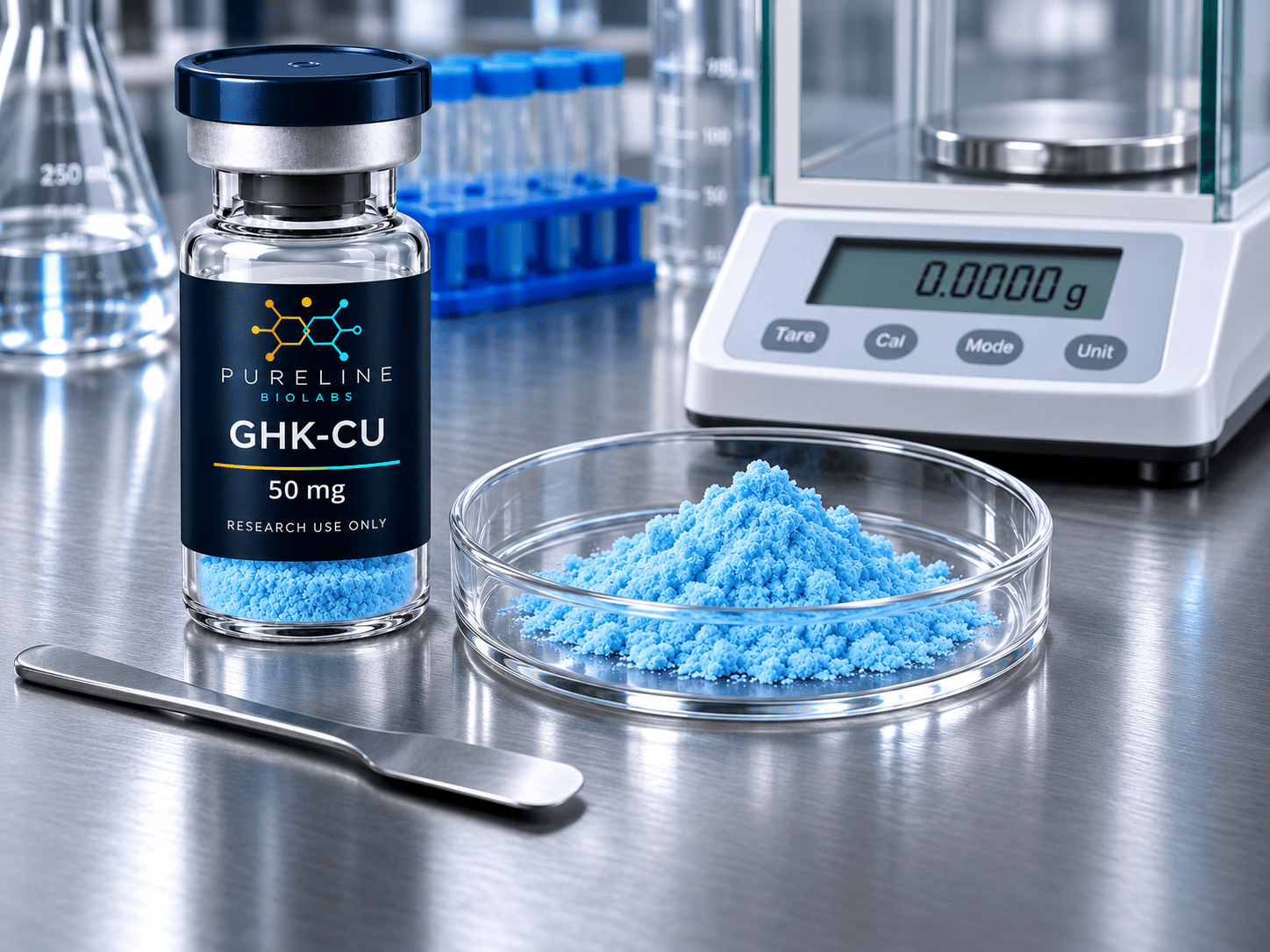
The amount printed on the label (for example 10 mg) refers to the target peptide. The visible cake can be larger or smaller than you might expect, because excipients and porosity change its volume. Our guide why lyophilised peptide vials look different explains this in detail.
Lyo Cakes vs Lyo Beads: What Is the Difference?
A lyo cake is freeze-dried inside its final vial as one solid; lyo beads are freeze-dried as many separate frozen droplets and then filled into a container. Both are lyophilised products, but they are made and handled differently [8,9].
How lyo beads are made
Lyo beads, also called lyospheres or lyophilised pellets, are produced by forming uniform droplets of the formulation, freezing each droplet rapidly (often with cryogenic cooling), and then freeze-drying the frozen spheres in bulk. The dried beads are packaged under controlled conditions [8]. Spray-freeze-drying is one established route to lyospheres [9].
| Feature | Lyo cake (vial-dried) | Lyo beads / lyospheres |
|---|---|---|
| Where it is dried | Inside the final vial | As separate frozen droplets, outside the final container |
| Form | One porous solid per vial | Many small, free-flowing spheres |
| Quantity per unit | Set by the liquid fill in each vial | Set by bead size and the number of beads dispensed |
| Equipment | Standard shelf freeze-dryer and vial lines | Specialised droplet-forming and cryogenic equipment |
| Strengths | Established, widely validated process; product sealed in-vial | Uniform units, fast dissolution, flexible dispensing, suits automation [8] |
| Limitations | Cake appearance can vary; drying time per batch can be long [2,3] | Complex formulation development; beads are moisture-sensitive once dried; mechanical robustness must be managed [8,9] |
| Typical uses | Peptide reference materials, many pharmaceutical products | Diagnostic reagents (e.g. PCR mixes), enzymes, vaccine development, assay kits [8] |
For small-quantity peptide reference materials, the vial-dried cake remains the standard format, because each vial is filled, dried and sealed as a single traceable unit linked to one batch.
Why Most Research Peptides Are Supplied as a Lyophilised Cake
- Stability. A dry solid keeps its purity for longer than the same peptide in solution [5,6].
- Traceability. Each vial is filled from one batch, so a single certificate of analysis can describe every vial in that batch.
- Transport. Sealed dry vials are less vulnerable to leakage and temperature excursions during shipping.
- Measurable content. The dry material can be tested for HPLC purity, mass spectrometry identity and peptide content, and those results stay meaningful for longer.
Lyophilised vs Pre-Mixed Peptides
Some sellers offer peptides already in solution, sometimes called pre-mixed. From a stability point of view, a liquid peptide product needs its own formulation work (pH, buffer, excipients, container and storage temperature) and its own stability data to show that purity and content hold up over its stated shelf life [4,10]. Without that data, a certificate of analysis tells you about the material at the time it was tested, not necessarily about the liquid weeks later.
This is why laboratory reference materials are normally supplied dry. Pureline Biolabs supplies all products as lyophilised solids in sealed vials, and does not supply peptides in solution.
What a Lyophilised Vial Can and Cannot Tell You
Appearance is a useful first check, but it is not evidence of quality. Industry guidance on cake appearance stresses that cosmetic variation is common and must be judged against the specific product [3].
| Question | Can appearance answer it? | What does |
|---|---|---|
| Is the closure intact? | Yes, visually | Visual inspection |
| Has the cake melted back or become wet? | Partly, as an obvious change | Residual moisture testing |
| Is it the right compound? | No | Mass spectrometry (identity) |
| How pure is it? | No | HPLC (area-percent purity) |
| How many milligrams are in the vial? | No | A quantitative content assay |
For how to check those results against a real report, see how to verify a peptide certificate of analysis and what peptide purity figures actually mean.
How Pureline Biolabs Supplies Its Peptides
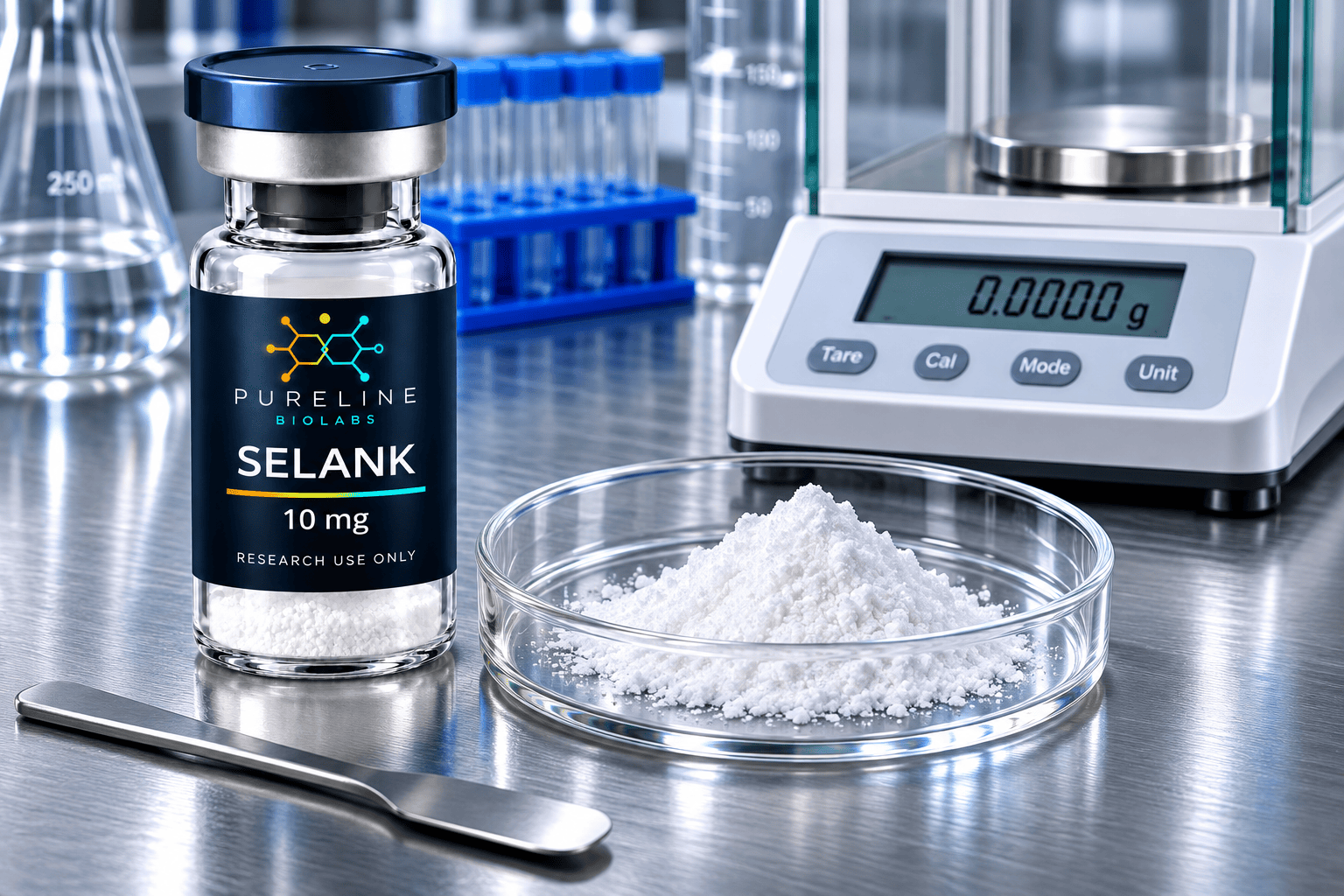
- Every product is supplied as a lyophilised solid in a sealed vial, with the batch number printed on the label.
- Every batch is independently tested by Janoshik Analytical for HPLC purity and LC-MS identity, with measured content reported. All certificates are published on our lab reports page.
- Stock is held in a laboratory refrigerator at 2–8 °C, with readings published on our cold chain log.
- Orders are dispatched in insulated packaging with refrigerant packs.
Key Takeaways
- Lyophilised means freeze-dried: water removed by sublimation under vacuum.
- Peptides are generally more stable as a dry lyophilised solid than in solution.
- Hydrolysis, deamidation, oxidation and aggregation are the main risks in solution, and sequence determines which apply.
- Lyo cakes are dried in the vial; lyo beads are dried as separate droplets. Both are lyophilised.
- Appearance cannot confirm identity, purity or quantity. Batch-specific analytical testing can.
Frequently Asked Questions
What does lyophilised mean?
Lyophilised means freeze-dried. The material is frozen, then its ice is removed as vapour under vacuum, leaving a dry porous solid. “Lyophilized” is the US spelling of the same word.
Are lyophilised peptides better than liquid peptides?
For storage and transport, lyophilised peptides are generally more chemically stable than the same peptides in solution, because low water content slows hydrolysis, deamidation and oxidation. A liquid product can be stable only if it has been specifically formulated and supported by its own stability data.
What is the difference between lyo beads and lyo cakes?
A lyo cake is one porous solid freeze-dried inside its final vial. Lyo beads, or lyospheres, are many small spheres made by freezing individual droplets and freeze-drying them separately, then filling them into a container. Both are lyophilised products.
What is a lyophilised vial?
A lyophilised vial is a sealed glass vial containing a freeze-dried material, usually closed with a rubber stopper and crimped aluminium cap so moisture and oxygen are kept out.
Why does a lyophilised peptide look like a cake or powder?
The solid forms around the spaces left by ice crystals, so it is porous and takes roughly the shape of the original liquid fill. It may stay intact, crack, shrink or appear as loose powder depending on formulation and drying conditions.
How should lyophilised peptides be stored?
Sealed, cold, dry and protected from light. Laboratory suppliers commonly recommend −20 °C or below for long-term storage of lyophilised peptides. Pureline holds its stock at 2–8 °C in a monitored laboratory refrigerator.
Can you tell peptide quality from the vial’s appearance?
No. Appearance can reveal an obvious problem such as a damaged closure, but identity, purity and quantity can only be confirmed by analytical testing such as mass spectrometry, HPLC and a content assay.
References
- US Food and Drug Administration. Lyophilization of Parenteral (7/93): freezing, primary drying and secondary drying.
- Tang X, Pikal MJ. Practical advice on scientific design of freeze-drying process.
- Patel SM, et al. Lyophilized Drug Product Cake Appearance: What Is Acceptable? 2017.
- Wang W. Instability, stabilization, and formulation of liquid protein pharmaceuticals. Int J Pharm. 1999;185(2):129–188.
- Carpenter JF, et al. Rational design of stable lyophilized protein formulations: theory and practice.
- Merck / Sigma-Aldrich. Peptide Stability and Potential Degradation Pathways.
- Wood VE, et al. Investigation of the Solid-State Interactions in Lyophilized Polypeptide Formulations. 2024.
- Lyophilization Core. Introduction to Lyo Beads. 2026.
- Spray-freeze-dried lyospheres: Solid content and the impact on flowability and mechanical stability. Powder Technology.
- Designing Formulation Strategies for Enhanced Stability of Therapeutic Peptides in Aqueous Solutions: A Review.
Last reviewed 24 November 2026. Questions or factual corrections: contact Pureline Biolabs.
Chris Harris
Co-director of Pureline Biolabs Ltd. Commissions the independent batch testing with Janoshik Analytical, reviews every certificate before stock is listed, and publishes all of them in full. Registered in England and Wales, Company No. 17236739.
All products supplied by Pureline Biolabs Ltd are intended solely for in vitro laboratory research purposes. They are not medicines, not approved for human or veterinary use, and not for human consumption. Pureline Biolabs Ltd · Company No. 17236739 · purelinebiolabs.com