

Peptide Lab Reports: How to Find and Read a Batch Report
A peptide lab report is only useful if you can find the right one and understand what it says. This guide shows where research peptide lab reports are published, walks through every field on a real batch report, explains what batch testing actually means, and lists the red flags worth knowing.
Quick Answer
A peptide lab report (also called a batch report, test report or certificate of analysis) is a document from an analytical laboratory recording what it found when it tested a sample from one specific batch. A good one names the laboratory, the client, the compound, the batch number and the test date, and gives results for identity, purity and measured content.
To find one, check the supplier’s lab reports page, the product page, the QR code or batch number on the vial label, or the testing laboratory’s own verification server. To read one, match the batch number to your vial, confirm the client is the supplier, check the dates, read the results, then confirm the report on the laboratory’s site using its unique key.
This article covers analytical documentation only: how lab reports are structured and how to check them. It does not describe how to prepare, use or administer any compound. All Pureline Biolabs products are supplied strictly for in vitro laboratory research.
- “Lab report”, “batch report”, “test report” and “COA” are used for the same kind of document.
- A report describes one sample from one batch. It only applies to vials carrying that batch number.
- The three results that matter most are identity, purity and content.
- A report is only trustworthy if it can be verified at the laboratory, not just viewed on a seller’s site.
- A lab report does not show that a compound is safe, approved or suitable for any use outside the laboratory.
What Is a Peptide Lab Report?
A peptide lab report is the written result of an analytical test on a peptide sample. The supplier (the client) sends one or more sealed vials to a testing laboratory, the laboratory runs the analyses that were ordered, and it issues a report with the results, the date and a reference number.
Different sellers and laboratories use different names for the same document:
| Name you may see | What it usually means |
|---|---|
| Lab report / test report | The laboratory’s own document for one test order (a “task”). |
| Batch report / batch analysis | A lab report tied to a specific production batch number. |
| Certificate of analysis (COA) | Formally, a document certifying a batch against a specification. In the research peptide market the term is often used for any lab report. |
| Third-party / independent report | A report issued by a laboratory that is not owned by the seller or the manufacturer. |
| In-house / manufacturer COA | A report produced by the factory that made the material. Useful, but not independent. |
In regulated pharmaceutical manufacturing, specifications for a peptide typically cover identity, purity and quantity, among other attributes [2,4]. Research peptide lab reports usually cover a smaller set, so it is worth knowing exactly which tests were ordered.
Where to Find a Peptide Lab Report
If you are trying to work out how to find a peptide lab report for a vial you have, or one you are thinking of ordering, look in these places, in this order:
- The supplier’s lab reports page. Transparent suppliers publish every current batch in one place, usually linked from the main menu. Ours is the lab reports page.
- The product page. Look for a batch or documents panel showing the batch number, test date and a link to the report.
- The vial label. The batch number printed on the label is what links your vial to its report. Some labels also carry a QR code.
- The laboratory’s verification server. Laboratories such as Janoshik Analytical host reports on their own site, reached with a unique key printed on the report [1].
- Ask the supplier. If you cannot find a report for your batch number, ask for it by batch number. A supplier who tests every batch should be able to send it promptly.
No report for your batch number means there is no independent evidence about that batch. A report for a different batch, a different compound or an undated “example” report does not count.
How to Read a Peptide Lab Report, Field by Field
The example below is a real Janoshik Analytical test report for one of our batches: Selank 10 mg, batch PLB-006, task #209940. Most independent peptide lab reports have similar fields, even if the layout differs.
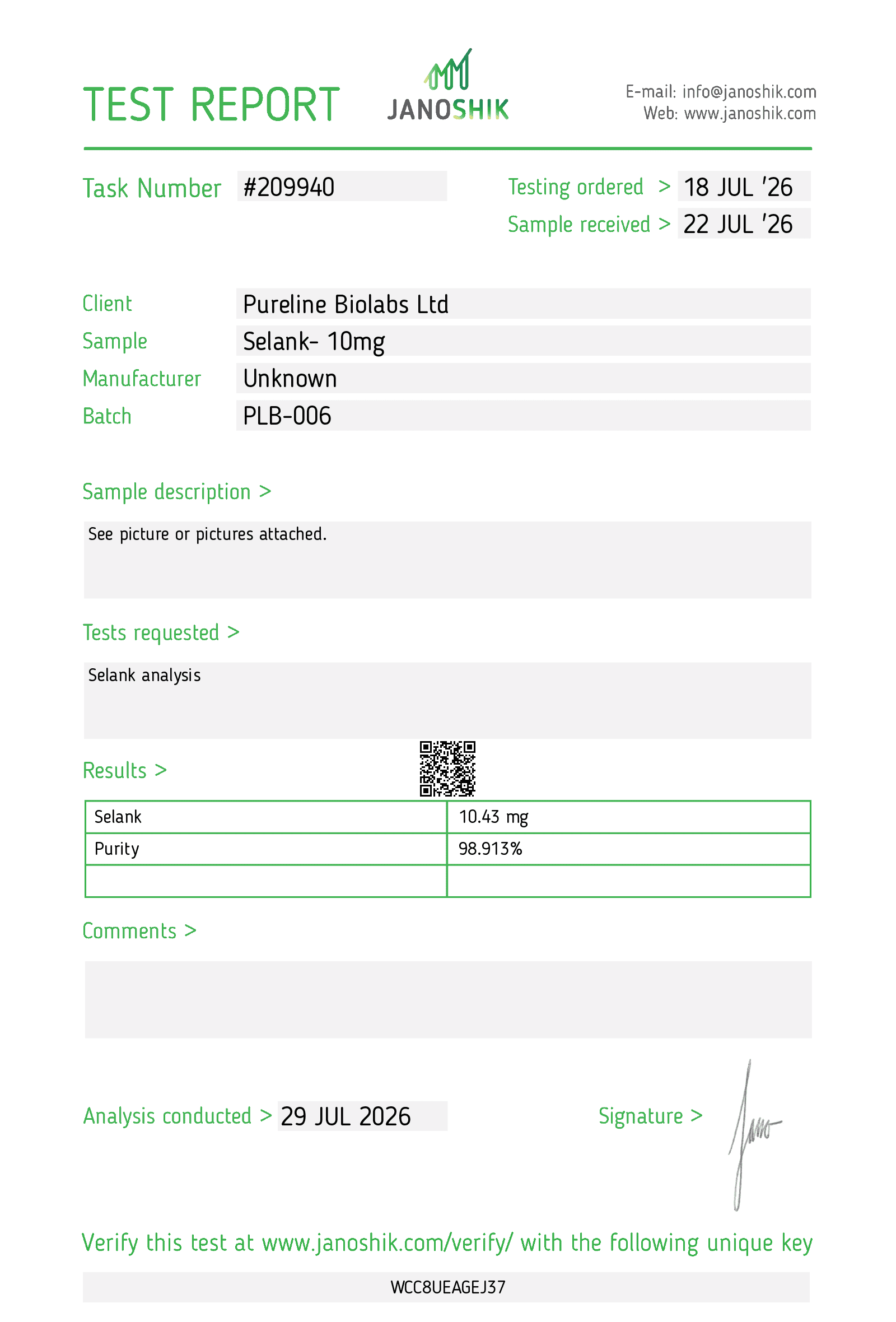
| Field | What it shows | What to check |
|---|---|---|
| Task number | The laboratory’s reference for this test order (#209940). | It should match the number in the verification link and on the supplier’s site. |
| Testing ordered / sample received | When the test was ordered (18 July 2026) and when the vial arrived at the lab (22 July 2026). | The dates should be in a sensible order and reasonably recent for the stock being sold. |
| Client | Who ordered the test (Pureline Biolabs Ltd). | It should be the supplier you are buying from, not another company. |
| Sample | The compound and labelled amount (Selank, 10 mg). | It should match the product and vial size. |
| Manufacturer | Whatever the client declared about origin. Here: “Unknown”. | See the note below. The lab tests the sample; it does not audit the factory. |
| Batch | The batch identifier (PLB-006). | It must match the batch number on your vial label exactly. |
| Sample description | Photos or a description of the vial as received. | On the verification page, the photos should look like the product you received. |
| Tests requested | The scope of analysis that was paid for (“Selank analysis”). | Know what was tested. Anything not ordered is not covered by the report. |
| Results | Measured content (10.43 mg) and HPLC purity (98.913%). | Read them against the label and the supplier’s claims. See the next section. |
| Comments | Anything the lab wants to note. Empty here. | Read any comment carefully; it can qualify the results. |
| Analysis conducted | The date the analysis was done (29 July 2026). | This is the “tested” date to compare with the age of the stock. |
| Verification key and QR code | A unique code (WCC8UEAGEJ37) that opens the report on the lab’s own server [1]. | Always use it. A key that does not verify, or verifies to a different report, is a serious red flag. |
Reading the Results Section
The results section is the heart of any peptide analysis report. There are three questions to answer.
1. Identity: is it the right compound?
Identity is normally confirmed by mass spectrometry (MS or LC-MS), which checks that the molecular mass of the main peak matches the expected compound. A purity figure without an identity check tells you that the sample is mostly one substance, not which substance. Our guide to what peptide purity figures actually mean explains why this matters.
2. Purity: how much of it is the target peptide?
Purity is usually reported as an HPLC area-percentage: the share of the detected signal that belongs to the main peak. 98.913% means the main peak made up just under 99% of what the detector saw. It is not the same as the percentage of the vial’s weight that is peptide.
3. Content: how much is in the vial?
Measured content (here 10.43 mg on a 10 mg label) is a quantitative result for the amount of target peptide in the vial tested. Real batches rarely hit the label exactly. Across our July 2026 batches, measured content on 10 mg vials ranged from 8.13 mg to 11.23 mg, and we publish every figure as measured. Where content runs low, the label should say so.
A high purity figure with content well below the label, or a perfect-looking content figure with no identity check, each tells only part of the story. A complete peptide batch report gives all three.
What Does Batch Testing Mean?
Batch testing means a sample from every production batch is tested, and each batch gets its own report. A batch is a quantity of material made and filled together, which is why vials from the same batch are expected to be very similar to one another and why one sample can represent it.
| Approach | What you get | Limitation |
|---|---|---|
| Every batch tested | A separate report linked to each batch number on sale. | Still one sample per batch, not every vial. |
| Occasional testing | Reports for some batches only. | Vials from untested batches have no evidence behind them. |
| One “reference” report | A single report reused for months or across batches. | Tells you nothing about the batch you actually receive. |
| Manufacturer COA only | The factory’s own results. | Not independent; cannot be checked at a third-party lab. |
When someone asks which research peptide sellers provide lab reports matching each vial’s batch, this is the test: can you take the batch number off your own label and find an independent, verifiable report for that exact batch?
Why Does a Report Say Manufacturer: Unknown?
It is common to see “Manufacturer: Unknown” on independent peptide testing reports. The field records only what the client chose to declare when ordering the test. The laboratory analyses the sample it receives; it does not inspect or certify the factory. The results apply to the sample whatever is written in that field.
That is also why a lab report is not a substitute for a manufacturer’s own quality records. They answer different questions: a lab report says what was in the vial tested; manufacturing records describe how the batch was made.
Red Flags in a Peptide Batch Report
- No batch number, or a batch number that does not match your vial.
- A different client name, meaning the report belongs to another seller.
- No verification key, or a key that does not open the same report on the laboratory’s own site.
- Old dates on stock that is described as a new batch.
- Purity only, no identity result.
- Edited-looking documents: mismatched fonts, blurred numbers or cropped headers.
- Reports “on request” that never arrive.
For a full step-by-step check, including a worked example, see how to verify a peptide certificate of analysis.
What a Lab Report Cannot Tell You
- Every vial. A report covers the sample tested. Other vials from the same batch are expected to be similar, but they were not individually tested.
- What happened after testing. Storage and transport after the test date can affect a peptide. That is why cold storage records matter alongside the report [5].
- Anything not ordered. If a test was not requested, the report says nothing about it.
- Safety or approval. A lab report is an analytical record. It does not show that a compound is safe, licensed or suitable for any use outside the laboratory.
- Laboratory accreditation. Some laboratories hold formal accreditation such as ISO/IEC 17025, which applies only to the specific activities on their schedule [3]. If accreditation matters to your work, check the laboratory’s own statement.
Peptide Transparency: What Good Looks Like
“Peptide transparency” gets used loosely. In practice, a transparent supplier makes these things easy:
- Every batch on sale has its own independent report, published without asking.
- The batch number on the label matches a report you can find in seconds.
- Each report verifies at the laboratory, not only on the seller’s site.
- Results are published as measured, including content below the label.
- Batches that failed testing are disclosed, not quietly replaced.
- Storage conditions between testing and dispatch are recorded.
Our guide to UK peptide supplier quality claims covers how to read the marketing around these points.
How Pureline Biolabs Publishes Its Batch Analysis
- One sealed vial from every batch is sent to Janoshik Analytical for HPLC purity and LC-MS identity, with measured content reported.
- Every report is published in full on our lab reports page, with a direct link to verify it on Janoshik’s server.
- Each product page shows a Batch & documents panel with the batch number, test date, result and task number.
- Only batches at or above 98% HPLC purity are listed. Batches that fell short are recorded in our rejection log.
- Stock is held at 2–8 °C, with readings published on our cold chain log.
Key Takeaways
- Lab report, batch report, test report and COA usually mean the same thing in this market.
- Find reports on the supplier’s lab reports page, the product page, the vial label or the lab’s verification server.
- Check the batch number, client, dates, tests requested and results, then verify the key at the laboratory.
- Read identity, purity and content together. Each answers a different question.
- A report covers one sample from one batch. It is analytical evidence, not a statement of safety or approval.
Frequently Asked Questions
What is a peptide lab report?
A peptide lab report is a document from an analytical laboratory recording the results of testing a peptide sample from one batch. It normally names the laboratory, client, compound, batch number and test date, and gives results for identity, purity and measured content.
How do I find a peptide lab report?
Check the supplier’s lab reports page, the product page, the batch number or QR code on the vial label, or the testing laboratory’s verification server. If you cannot find a report for your batch number, ask the supplier for it by batch number.
What is a peptide batch report?
A peptide batch report is a lab report linked to a specific production batch number. It applies only to vials carrying that batch number, so the batch number on the report must match the one on the vial label.
Is a lab report the same as a certificate of analysis?
In the research peptide market the terms are used interchangeably. Formally, a certificate of analysis certifies a batch against a set specification, while a test report records the results of the analyses ordered.
What does batch testing mean?
Batch testing means a sample from every production batch is tested and each batch gets its own report. It is different from reusing one reference report across many batches, which tells you nothing about the batch you receive.
Why does my peptide lab report say “Manufacturer: Unknown”?
The manufacturer field records only what the client declared when ordering the test. The laboratory analyses the sample it receives and does not inspect the factory, so the results apply to the sample regardless of that field.
Does a lab report prove a peptide is safe?
No. A lab report is an analytical record of identity, purity and content for the sample tested. It does not show that a compound is safe, licensed or suitable for any use outside the laboratory.
References
- Janoshik Analytical. Test verification: reports verified using the unique key printed on each report.
- European Medicines Agency. Guideline on the development and manufacture of synthetic peptides. EMA/CHMP/CVMP/QWP/367182/2025, effective 1 June 2026.
- UKAS. Accreditation for testing laboratories (ISO/IEC 17025).
- ICH. Q6B: Specifications, test procedures and acceptance criteria for biotechnological/biological products.
- Merck / Sigma-Aldrich. Peptide Stability and Potential Degradation Pathways.
Last reviewed 24 November 2026. Questions or factual corrections: contact Pureline Biolabs.
Chris Harris
Co-director of Pureline Biolabs Ltd. Commissions the independent batch testing with Janoshik Analytical, reviews every certificate before stock is listed, and publishes all of them in full. Registered in England and Wales, Company No. 17236739.
All products supplied by Pureline Biolabs Ltd are intended solely for in vitro laboratory research purposes. They are not medicines, not approved for human or veterinary use, and not for human consumption. Pureline Biolabs Ltd · Company No. 17236739 · purelinebiolabs.com